
A mysterious feline shape emerges from the darkness
Space is full of extraordinary structures, but occasionally the universe produces something that looks almost familiar.
In a remarkable new set of observations released on October 29, 2026, NASA’s James Webb Space Telescope has revealed intricate details of a cosmic structure nicknamed the Cat’s Head Nebula. Located within the enormous Carina Nebula, the formation resembles a cat sitting with its back toward the viewer, its head turned to one side and a bright feature resembling a glowing eye.
The resemblance is striking, but the science behind the image is even more fascinating.
What appears to be a ghostly animal floating in space is actually a complicated arrangement of gas, dust, young stars and material being reshaped by intense radiation from massive nearby stars.
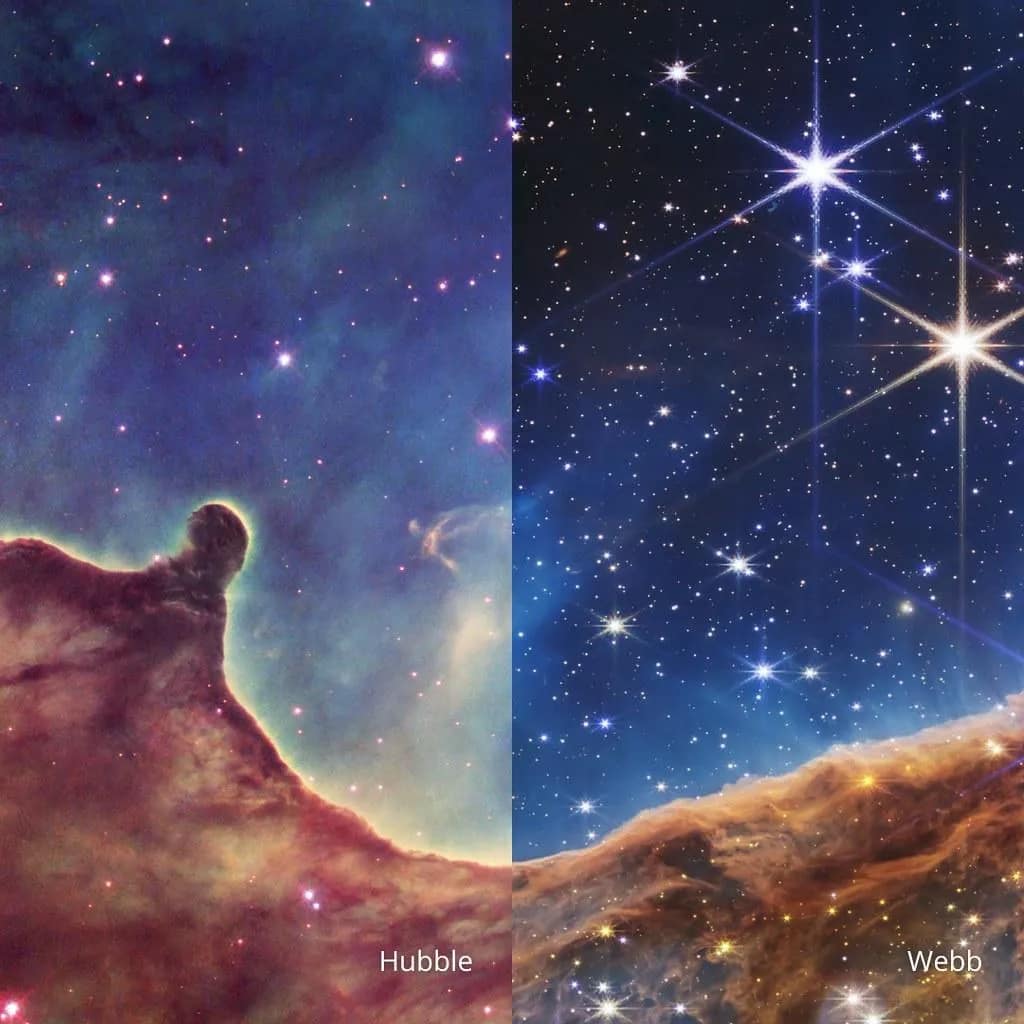
The new observations bring together views from two of humanity’s most powerful space observatories: NASA’s Hubble Space Telescope and the James Webb Space Telescope. Each sees the same region differently, revealing features that would otherwise remain hidden.
The result is more than an extraordinary astronomical photograph. It offers astronomers another opportunity to investigate how stars form, how radiation transforms their surroundings and how temporary structures emerge inside enormous clouds of cosmic material.
Where exactly is the Cat’s Head Nebula?
The Cat’s Head Nebula is located approximately 7,500 light-years from Earth, within the Carina Nebula, a vast region of gas and dust in the constellation Carina.
That means the light captured by Webb began its journey toward Earth approximately 7,500 years ago.
The larger Carina Nebula is an active stellar environment containing massive stars, glowing gas clouds and regions where new stars are forming. These environments are particularly interesting to astronomers because the birth of stars can dramatically change the surrounding material.
The Cat’s Head structure is a relatively small feature within this much larger cosmic landscape. Its distinctive appearance comes from an elongated pillar of dense dust and gas that has resisted erosion more effectively than the surrounding material.
It is not a solid object, nor is it an actual cloud shaped like an animal. Its outline is the result of complicated physical processes involving gravity, radiation, temperature and stellar winds.
NASA’s observations place the photographed region at roughly 5.4 light-years across in the image’s field of view.
What is creating the cat-shaped structure?
The answer involves one of the most powerful forces influencing star-forming regions: massive stars.
These stars release enormous amounts of energy through ultraviolet radiation and powerful stellar winds. When this energy encounters nearby clouds of gas and dust, it can heat, compress and gradually erode the material.
Over long periods, this interaction can create dramatic structures such as pillars, ridges, filaments and dense globules.
In the Cat’s Head region, the surrounding material has been exposed to radiation from nearby massive stars. Less dense material is gradually stripped away, while denser sections resist the erosion for longer.
This process helps explain why the central pillar has retained its unusual shape.
Astronomers refer to this broader influence as stellar feedback. It is important because stars do not simply emerge from their surrounding clouds and leave everything unchanged. Once they form, they can influence the conditions in which other stars develop.
In some circumstances, radiation compresses nearby gas and may encourage new star formation. In others, it disperses the material needed to create future stars.
The same environment can therefore help create stars while eventually destroying the structures from which they formed.
Webb sees what ordinary telescopes cannot
One of the most important aspects of this discovery is the difference between visible-light and infrared astronomy.
Hubble and Webb are not simply taking two versions of the same photograph. They observe different wavelengths, allowing scientists to investigate different physical properties of the same region.
Hubble reveals the visible-light appearance
Hubble’s observations show the cat-shaped pillar as a dark brown, opaque structure against a colourful background of illuminated gas.
The bright rim along one side of the pillar is particularly interesting. It is consistent with gas being illuminated and ionized by ultraviolet radiation from nearby massive stars.
The glowing feature resembling the cat’s eye may be a young star that remains partially embedded within the surrounding dust.
Hubble also reveals colourful emissions associated with oxygen, hydrogen and sulfur, as well as starlight scattered by dust.
However, visible light cannot easily pass through dense concentrations of dust. Important structures behind the cloud can therefore remain hidden.
Webb’s near-infrared vision penetrates the dust
This is where the James Webb Space Telescope becomes particularly valuable.
Its Near-Infrared Camera, known as NIRCam, observes wavelengths that can pass through some dust that blocks visible light.
Instead of seeing only a dark pillar, astronomers can examine more of its internal structure and surrounding environment.
Webb’s near-infrared observations reveal a dense scattering of stars, complex surface details and faint wisps of gas and dust on the left side of the pillar.
Some stars remain obscured even at infrared wavelengths, demonstrating just how dense certain parts of the cloud can be.
The observations also reveal faint background galaxies. In other words, Webb is not only studying material inside our own galaxy but also allowing glimpses of much more distant objects through gaps in the foreground material.
Mid-infrared observations reveal warm dust and molecules
Webb’s Mid-Infrared Instrument, or MIRI, provides another perspective.
Rather than concentrating primarily on the visible appearance of stars, mid-infrared observations reveal emissions from warm dust and carbon-based molecules excited by nearby starlight.
These emissions outline intricate structures within the nebula.
Small globules and delicate strands of material become particularly noticeable to the left of the main pillar.
A bright source to the right of the pillar is also visible. Researchers believe it is likely an infant star embedded in dust, although the image alone cannot establish every detail of its surroundings.
The different brightness and colour patterns help scientists investigate variations in the local conditions and composition of the cloud.
The glowing eye: Is a newborn star hiding inside the nebula?
Perhaps the most intriguing detail in the new observations is the bright feature that looks like the cat’s eye.
Astronomers believe this luminous region may contain a young star still partially embedded in dust.
That possibility is scientifically important.
Stars are born inside enormous clouds of gas and dust. Under suitable conditions, gravity pulls parts of these clouds together. As material accumulates, the central region becomes increasingly dense and hot, eventually allowing nuclear fusion to begin.
However, the earliest stages of stellar development are difficult to observe because the surrounding dust blocks much of the visible light.
Infrared astronomy helps overcome this problem.
If the bright feature really does contain an infant star, Webb’s observations could help researchers investigate how young stars interact with the material surrounding them.
There is another intriguing detail. ESA’s description of the near-infrared image identifies a faint jet-like feature near the cat’s belly that could be associated with a stellar outflow. Its origin remains uncertain.
Such outflows can be associated with young stars as material falls inward and some of it is redirected outward along powerful jets.
It is an important reminder that star formation is not a quiet process. Even a seemingly peaceful cloud can contain energetic activity hidden beneath layers of dust.
Could the nebula be a stellar nursery?
The Cat’s Head region is part of a much larger star-forming environment, and its structures provide clues about the complicated relationship between young stars and their surroundings.
Star formation generally begins when sufficiently dense regions of molecular gas become gravitationally unstable.
As gravity pulls material inward, a protostar develops. It continues gathering gas and dust while its temperature and pressure increase.
Eventually, conditions in its core become sufficient for hydrogen fusion.
But the process does not happen in isolation.
Massive neighbouring stars can release ultraviolet radiation that heats nearby gas. Their stellar winds can push surrounding material away, creating cavities and sculpting dense clouds into pillars and filaments.
This interaction can have two competing effects:
-
Star formation can be encouraged: Compression may make some regions of gas denser, potentially triggering gravitational collapse.
-
Star formation can be interrupted: Radiation and stellar winds can remove the surrounding material, depriving developing stars of the gas they need.
The Cat’s Head structure illustrates how these competing forces can shape a star-forming environment.
Its dense central material has resisted erosion, while more exposed material around it is being transformed by radiation.
Over time, the structure will change and eventually disperse. The cat-like appearance is therefore temporary, even though the physical processes behind it are part of the continuing life cycle of stars.
Why astronomers need both Hubble and James Webb
It is tempting to think that Webb simply replaces Hubble because it is newer and more technologically advanced.
That is not how modern astronomy works.
The two observatories have different capabilities, and their observations are particularly valuable when combined.
| Telescope | What it reveals |
|---|---|
| Hubble | Visible-light structures, dark dust pillars and glowing gas |
| Webb NIRCam | Stars, dust structures and material visible through near-infrared wavelengths |
| Webb MIRI | Warm dust, carbon-based molecular emissions and intricate mid-infrared structures |
The Cat’s Head observations demonstrate why studying the same astronomical object at different wavelengths is so useful.
A cloud that appears dark in visible light may reveal a complicated collection of stars and structures in infrared observations.
Likewise, features that appear bright in mid-infrared wavelengths can tell astronomers about warm dust and molecular material rather than simply showing the locations of stars.
Combining these observations helps scientists build a more complete picture of the physical environment.
What could scientists discover next?
The latest observations raise several interesting scientific questions.
1. What exactly is happening inside the glowing eye?
If the bright region contains a young star, further observations could help establish its characteristics and how deeply it remains embedded in the surrounding dust.
2. What is producing the faint jet-like feature?
The possible stellar outflow identified near the structure deserves further investigation. Astronomers will need additional evidence to establish its origin and whether it is connected to a young star.
3. How quickly is stellar radiation destroying the pillar?
The surrounding ultraviolet radiation is gradually changing the cloud. Understanding the erosion process could help researchers investigate how long such structures survive.
4. Are new stars forming in the compressed material?
Dense globules and filaments can provide suitable conditions for gravitational collapse. Further observations could help determine whether some of these structures are developing into new stars.
These are questions that cannot necessarily be answered by a single spectacular photograph. They require detailed observations, measurements and comparisons across different wavelengths.
The new images provide an important starting point rather than a complete explanation of everything happening inside the cloud.
A cosmic structure that will not last forever
One of the most fascinating aspects of the Cat’s Head Nebula is that its unusual appearance is temporary.
The structure exists because different physical forces are competing against one another.
Gravity helps dense material collect. Radiation heats exposed gas. Stellar winds push surrounding material outward. Dust absorbs and scatters light, creating the complicated shapes visible in telescope observations.
Eventually, the surrounding material will be dispersed or transformed.
The cat-shaped pillar will not remain frozen in its current form. Its appearance will change as the nearby stars continue influencing the environment.
This is a useful reminder that nebulae are not static decorations in space. They are dynamic environments where stars are born, evolve and influence the material around them.
The bigger picture: Webb is revealing how stars are born
The latest Cat’s Head observations are a wonderful example of what modern astronomy can accomplish.
A dark cloud that once appeared relatively featureless under visible light now reveals delicate filaments, warm dust, possible newborn stars and even distant galaxies in the background.
The James Webb Space Telescope is allowing astronomers to investigate the environments where stars develop with a level of detail that was previously difficult to achieve.
And perhaps that is the most interesting part of this discovery.
The Cat’s Head Nebula may look like a mysterious cosmic animal, but behind its unusual silhouette is a natural laboratory showing how the universe continually transforms clouds of gas and dust into new generations of stars.
The glowing eye may be a newborn star. The surrounding structures may be evidence of powerful stellar radiation. And the entire formation may eventually disappear as the forces shaping it continue their work.
For now, approximately 7,500 light-years away, the universe has given us a remarkable view of a stellar nursery that looks almost alive.




