

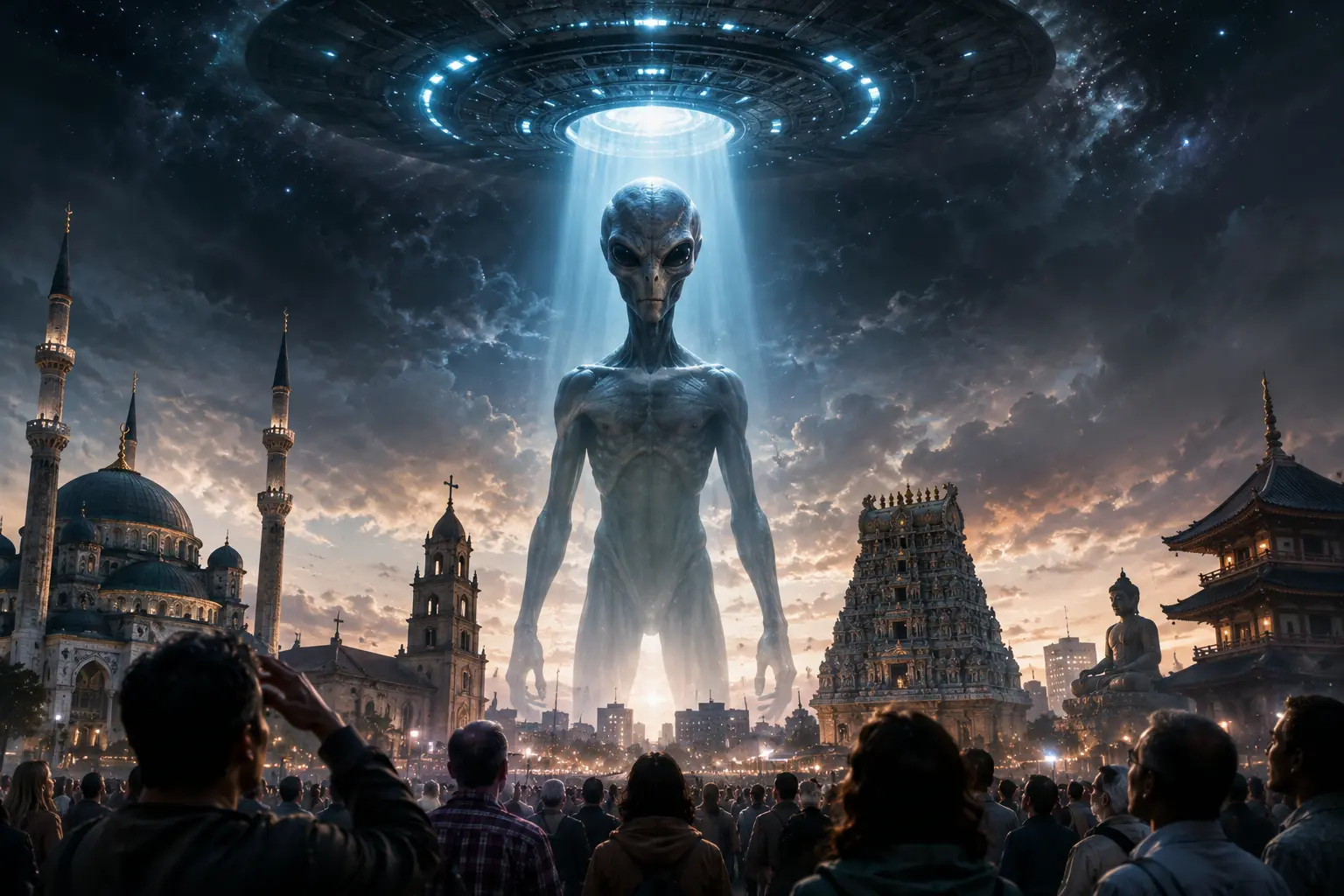
Few discoveries have the power to rewrite human history. The realization that Earth orbits the Sun transformed astronomy. Evolution reshaped biology. The discovery of DNA revolutionized medicine. But there is one breakthrough that could surpass them all—undeniable proof that intelligent extraterrestrial life exists.
For centuries, people have looked at the night sky and wondered whether humanity is alone in the universe. Today, that question is no longer confined to science fiction. Powerful space telescopes are identifying potentially habitable planets, and scientists continue searching for signals from distant civilizations.
If one day the evidence became impossible to deny, the consequences would reach far beyond science. It would influence politics, education, philosophy, culture, and perhaps most importantly, religion.
But would such a discovery really end every religion overnight?
The answer is far more complex than the headline suggests.
Humanity’s Biggest Discovery
Finding intelligent alien life would instantly become the greatest scientific achievement in history. It would confirm that life is not unique to Earth and that intelligence can emerge elsewhere in the universe.
This wouldn’t be another interesting space mission or an exciting astronomical discovery. It would completely change how humans view themselves.
For thousands of years, civilizations believed Earth occupied a special place in creation. Even after science proved our planet is just one of billions orbiting countless stars, humanity remained the only known intelligent species.
That assumption would disappear overnight.
Instead of asking whether aliens exist, the world’s attention would shift to far more difficult questions.
Who are they?
How advanced are they?
Have they been watching us?
And perhaps the biggest question of all—what does their existence mean for our beliefs?
Would Religion Really Collapse?
Despite sensational headlines, history suggests the answer is probably no.
Religion has survived countless scientific revolutions.
When astronomers proved the Earth revolves around the Sun, many predicted faith would disappear. It didn’t.
When Charles Darwin introduced the theory of evolution, similar predictions followed. Yet billions of people today accept modern science while maintaining religious beliefs.
Faith has often adapted to new discoveries rather than vanished because of them.
The discovery of intelligent aliens would certainly challenge long-held assumptions, but many religious scholars believe it wouldn’t automatically contradict belief in a creator.
Instead, it could expand humanity’s understanding of creation itself.
The Questions Every Religion Would Need to Answer
Proof of extraterrestrial intelligence would immediately raise questions that theologians have debated for decades.
Among them are:
- Were alien civilizations also created by God?
- Do intelligent extraterrestrials possess souls?
- Would they have their own prophets or sacred traditions?
- Do universal moral laws apply across different worlds?
- Is humanity still unique if intelligent life exists elsewhere?
These questions have no universally accepted answers, but many religious thinkers have already explored them.
Some argue that an all-powerful creator could easily create countless civilizations throughout the cosmos.
Others believe humanity’s spiritual significance would remain unchanged regardless of how many worlds are inhabited.
The conversation would likely evolve rather than end.
The Discovery That Could Truly Shake Belief
Simply finding alien life probably wouldn’t end religion.
Finding evidence that ancient religious events were actually encounters with advanced extraterrestrials would be a very different story.
Imagine researchers discovering an alien civilization millions of years older than humanity.
Now suppose those beings possessed detailed historical records of Earth’s earliest civilizations.
If those records suggested that events humans interpreted as divine miracles were actually interactions with advanced visitors, the implications would be staggering.
Entire chapters of human history would require careful re-examination.
However, it is important to separate speculation from evidence.
There is currently no credible scientific proof supporting claims that aliens influenced ancient civilizations or inspired religious traditions. These ideas remain popular in books, documentaries, and fictional stories but have not been verified by mainstream archaeology or astronomy.
Extraordinary claims require extraordinary evidence.
Science Would Demand Proof
If someone announced that aliens had rewritten human history, scientists would not simply accept the claim.
Evidence would need to withstand years of independent testing.
Researchers would expect:
- Physical alien technology available for examination.
- Independent verification by laboratories worldwide.
- Transparent scientific data.
- Repeatable observations.
- Peer-reviewed analysis from experts across multiple disciplines.
Without overwhelming evidence, such claims would remain speculation rather than established science.
This rigorous process is exactly what gives science its credibility.
A Planet Changed Forever
Religion would not be the only institution facing change.
Governments would coordinate on an unprecedented scale.
Financial markets could experience major uncertainty.
Space exploration budgets would likely increase dramatically.
Universities would establish entirely new fields of research focused on alien biology, communication, and technology.
School textbooks would be rewritten almost immediately.
Children born after the discovery would grow up in a world where humanity is no longer considered alone.
National identities might gradually become less important than a shared identity as inhabitants of Earth.
For the first time, the phrase “human civilization” could become more meaningful than individual countries.
What If Aliens Have Their Own Religions?
One fascinating possibility rarely discussed is that extraterrestrials might have spiritual beliefs of their own.
Perhaps they developed religions thousands or even millions of years before humanity.
Maybe they reached scientific discoveries that strengthened rather than weakened their faith.
Or perhaps they abandoned religion entirely after answering questions humans still struggle with today.
Without evidence, every possibility remains open.
Their beliefs—or lack of them—could teach humanity as much about ourselves as about them.
Why This Discovery Would Unite Science and Philosophy
The confirmation of intelligent alien life would not simply be a scientific milestone.
It would become a philosophical turning point.
Scientists would investigate biology, chemistry, technology, and communication.
Philosophers would debate consciousness, ethics, and identity.
Religious scholars would revisit ancient texts through a completely new lens.
Rather than replacing one field with another, the discovery could encourage unprecedented collaboration between science, philosophy, and theology.
The Bigger Picture
History shows that humanity rarely abandons its deepest beliefs overnight.
Instead, societies adapt, reinterpret, and evolve.
The discovery of intelligent extraterrestrial life would almost certainly challenge long-held assumptions, but it would not automatically erase religion.
Instead, it could inspire billions of people to ask deeper questions about creation, purpose, and humanity’s place in an unimaginably vast universe.
Whether faith grows stronger, weaker, or simply changes shape would depend not on the discovery itself, but on how humanity chooses to understand it.
One thing, however, is almost certain.
The day we confirm intelligent life beyond Earth will become the day human history begins a completely new chapter.
Frequently Asked Questions
Has intelligent alien life ever been discovered?
No. Despite decades of scientific searches, there is currently no confirmed evidence that intelligent extraterrestrial civilizations exist.
Would discovering aliens prove religions false?
Not necessarily. Many religious traditions can accommodate the possibility of life elsewhere in the universe, and scholars have explored this idea for years.
Could aliens have their own religion?
It is possible, but there is no evidence either way. Any discussion about alien belief systems remains speculative.
Why would this discovery matter so much?
It would answer one of humanity’s oldest questions—whether we are alone—and fundamentally reshape science, philosophy, and our understanding of the universe.


