

Imagine standing outside on a clear night and looking toward the nearest stars. Somewhere around one of those distant points of light could be another planet with oceans, mountains, clouds—or perhaps even life.
There’s just one frustrating problem.
They’re unbelievably far away.
Our fastest spacecraft are impressive when measured against anything humans built before the Space Age, but traveling between stars requires an entirely different level of technology. With conventional propulsion, reaching even our nearest stellar neighbors would take thousands—or tens of thousands—of years.
But scientists aren’t necessarily planning to use conventional rockets.
Researchers are exploring technologies ranging from laser-powered spacecraft and nuclear fusion engines to antimatter propulsion and even speculative concepts involving the fabric of spacetime itself.
Interstellar travel remains an enormous challenge, but for the first time in history, some possible solutions can be described using technologies and physical principles we actually understand.
Why Traveling to Another Star Is So Difficult
The biggest obstacle isn’t building a spacecraft.
It’s distance.
The nearest star system to our own, Alpha Centauri, lies roughly 4.37 light-years away, while Proxima Centauri—the closest individual star—is about 4.24 light-years from Earth.
A light-year is the distance light travels during an entire year, approximately 9.46 trillion kilometers.
That means Proxima Centauri is roughly 40 trillion kilometers away.
Even the Voyager probes, which are traveling through interstellar space after leaving the planetary region of our Solar System, aren’t remotely fast enough for practical journeys to another star.
To make interstellar exploration realistic, spacecraft probably need to travel at a meaningful fraction of the speed of light.
And that’s where things become interesting.
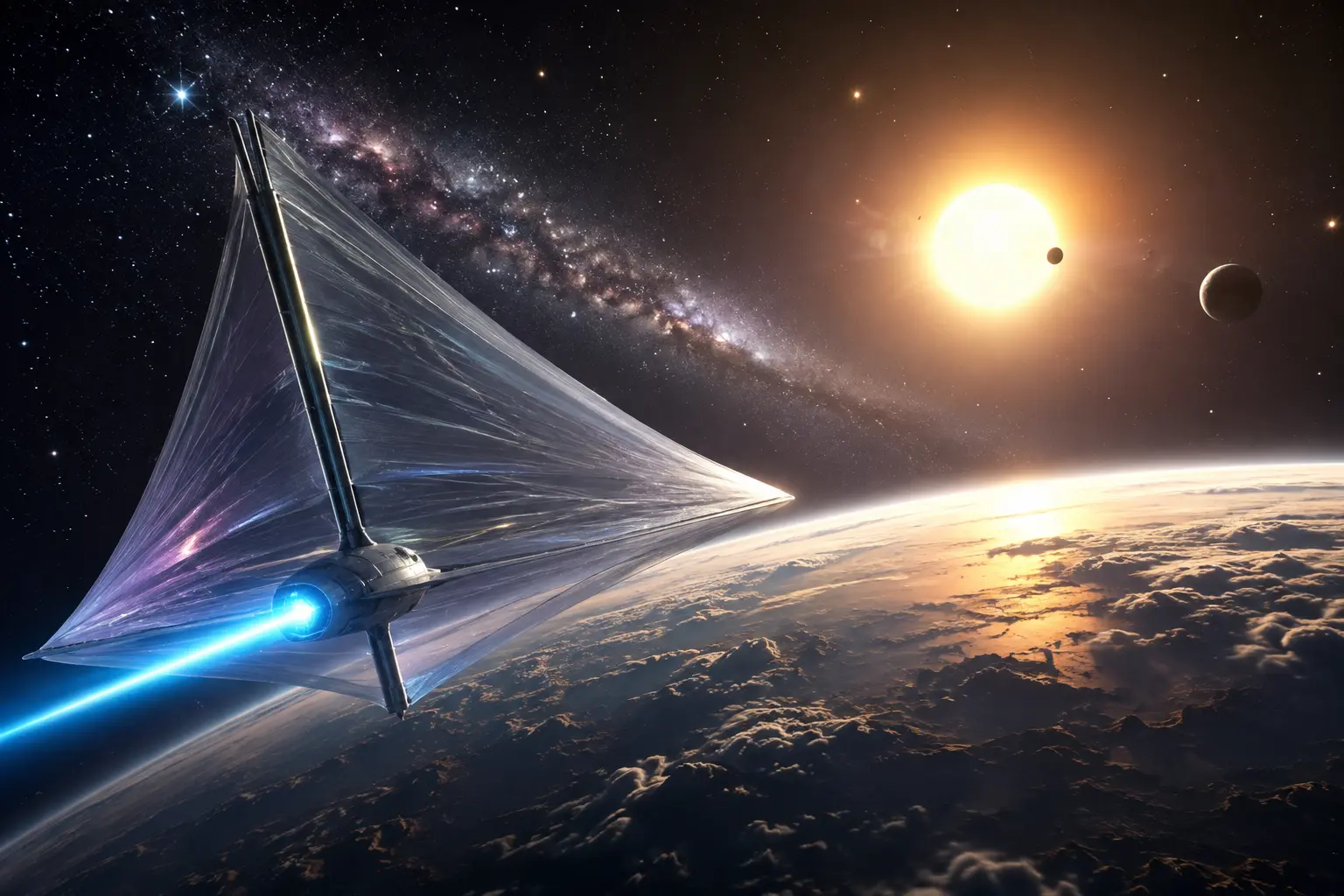
1. Laser-Powered Light Sails Could Change Everything
One of the most intriguing possibilities doesn’t involve carrying enormous tanks of fuel.
Instead, the spacecraft could essentially sail on light.
A light sail is an extremely thin reflective surface. When photons strike the sail, they transfer a tiny amount of momentum.
Each photon provides almost no push.
But bombard the sail with an extraordinarily powerful laser beam, and those tiny pushes begin adding together.
The result could be remarkable acceleration.
The best-known proposal using this concept is Breakthrough Starshot, an initiative investigating whether tiny robotic spacecraft attached to lightweight sails could eventually be accelerated to a substantial fraction of light speed.
The concept envisions powerful ground-based lasers pushing miniature probes toward the Alpha Centauri system.
At around 20% of light speed, a spacecraft could theoretically cross the distance in roughly two decades, excluding acceleration, deceleration and other mission considerations.
Suddenly we’re talking about decades rather than millennia.
That’s a dramatic change.
2. Nuclear Fusion Could Become the Engine of the Stars
There’s another technology scientists have pursued for decades that could transform both energy production and space exploration:
Nuclear fusion.
Fusion powers the Sun.
Under enormous temperature and pressure, lightweight atomic nuclei combine into heavier ones while releasing tremendous quantities of energy.
Researchers are attempting to reproduce controlled fusion reactions here on Earth.
If practical fusion propulsion becomes possible, spacecraft could potentially achieve velocities far beyond those available from conventional chemical rockets.
Instead of burning fuel and expelling hot gases, a fusion spacecraft could use the products of nuclear reactions to generate thrust.
There have already been serious theoretical studies of this idea.
Project Daedalus, developed by the British Interplanetary Society during the 1970s, examined whether an unmanned fusion-powered spacecraft could reach another star within a human lifetime.
Modern technology still isn’t ready to build such a vehicle.
But the underlying idea remains fascinating.
Master fusion propulsion and humanity could gain an extraordinarily powerful engine for exploring deep space.
3. Antimatter Could Provide Incredible Amounts of Energy
If fusion sounds powerful, antimatter takes things another step.
When matter encounters its antimatter counterpart, the two can annihilate, converting their mass into other forms of energy.
That makes antimatter enormously energy dense.
In principle, an antimatter-powered spacecraft could reach tremendous speeds while carrying considerably less reaction fuel than conventional propulsion systems would require for comparable energy.
Unfortunately, there’s a major catch.
Actually producing antimatter is extraordinarily difficult and expensive, and humans currently manufacture only microscopic quantities.
Then there’s the storage problem.
Antimatter cannot simply be placed inside an ordinary fuel tank because touching normal matter would cause annihilation.
It must instead be carefully contained, potentially using electromagnetic fields.
So antimatter engines aren’t appearing at a spacecraft dealership anytime soon.
But physics doesn’t simply prohibit the concept.
It’s largely an engineering and energy challenge—and an enormous one.
4. Could We Ride Through Spacetime Instead?
Here’s where interstellar travel becomes considerably stranger.
Rather than making a spacecraft travel faster and faster, what if we manipulated the space surrounding it?
This is the basic inspiration behind the famous warp-drive concept.
In 1994, physicist Miguel Alcubierre proposed a theoretical solution within general relativity involving a region of spacetime contracting ahead of a spacecraft while expanding behind it.
The spacecraft wouldn’t necessarily move locally through space faster than light.
Instead, spacetime itself would be distorted.
There’s an enormous problem, however.
Traditional versions of the idea appear to require exotic physical conditions, including negative energy densities, that we don’t currently know how to produce or control in the required way.
Consequently, warp drives remain highly speculative.
They’re fascinating physics—not available engineering.
5. Artificial Intelligence Could Pilot Interstellar Spacecraft
Propulsion isn’t the only problem.
Imagine sending a spacecraft 20 light-years away.
A radio message from Earth would require 20 years to reach it.
Another message returning to Earth would require another 20 years.
You can’t exactly call mission control and ask what to do.
Future interstellar spacecraft would therefore need extraordinary levels of autonomy.
Advanced artificial intelligence could potentially diagnose mechanical problems, navigate unexpected obstacles, choose scientific targets and modify mission objectives without waiting for instructions from Earth.
An interstellar spacecraft might effectively become a robotic scientist capable of making decisions independently for decades.
That could prove just as important as the engine powering it.
The First Interstellar Travelers Probably Won’t Be Humans
Here’s something Hollywood frequently gets backward.
Our first serious interstellar spacecraft probably won’t contain astronauts.
They could be tiny robots.
Small probes require less energy to accelerate, fewer resources to operate and don’t need oxygen, food, water or radiation protection for human passengers.
A swarm of miniature probes could potentially cross interstellar distances, photograph another planetary system and transmit information back toward Earth.
Those pictures would represent something extraordinary:
Humanity’s first close-up view of worlds orbiting another star.
Could Humans Eventually Follow?
Sending people is dramatically harder.
Humans need food, water, breathable air, protection against radiation and reliable life-support systems capable of operating for years or decades.
One possibility is a generation ship.
Rather than completing the journey during one person’s lifetime, hundreds or thousands of people could live aboard an enormous spacecraft.
Children would be born onboard.
Generations could pass.
Eventually, descendants of the original passengers would reach another star.
Other proposed solutions include suspended animation or extremely advanced biological technologies capable of slowing human metabolism.
At present, neither provides a proven solution for interstellar missions.
But history has repeatedly demonstrated that technologies can advance in directions earlier generations struggle to anticipate.
Interstellar Travel Might Be Closer Than It Looks
We shouldn’t expect starships next year—or probably even within the next few decades.
The technical barriers remain enormous.
But something important has changed.
Interstellar travel is no longer discussed exclusively through fictional spacecraft.
Scientists and engineers can investigate laser sails.
They can develop fusion experiments.
Physicists can study antimatter.
Astronomers are discovering potentially interesting planets around nearby stars.
Engineers can design increasingly autonomous spacecraft.
Each technology solves another small piece of an enormous puzzle.
Final Thoughts: Humanity’s Biggest Journey May Still Be Ahead
For almost all of human history, the stars were unreachable lights in the night sky.
Then we discovered what they were.
We learned how far away they were.
We discovered planets orbiting them.
And now we’re beginning to seriously consider how spacecraft might someday reach them.
Perhaps the breakthrough will be fusion.
Perhaps lasers will push microscopic spacecraft across interstellar space.
Perhaps some technology that hasn’t been invented yet will completely change the equation.
Nobody knows.
But somewhere in the future, humanity could experience a remarkable moment.
A spacecraft will leave our Solar System with another star as its destination.
And unlike the explorers who crossed Earth’s oceans centuries ago, those travelers—robotic or human—won’t simply be leaving home.
They’ll be leaving the Sun behind.
Frequently Asked Questions
What is the biggest obstacle to interstellar travel?
Distance and the enormous energy required to accelerate spacecraft to sufficiently high velocities are among the biggest obstacles. Radiation, communication delays, spacecraft reliability and human survival create additional challenges.
What technology could make interstellar travel possible?
Promising or frequently studied concepts include laser-powered light sails, nuclear fusion propulsion, advanced nuclear engines and, much further from practical implementation, antimatter propulsion.
Could humans travel to another star?
Nothing in known physics automatically rules out slower-than-light human interstellar travel, but the engineering requirements would be extraordinary. Life support, radiation protection, propulsion and mission duration remain major barriers.
How long would reaching Proxima Centauri take?
Proxima Centauri is approximately 4.24 light-years away. A hypothetical spacecraft traveling at 20% of light speed could cover that distance in a little over 21 years in a simplified calculation, although real missions would have to account for acceleration, navigation and potentially slowing down at the destination.
Is warp drive actually possible?
Warp-drive geometries can be explored mathematically within general relativity, but that doesn’t mean we know how to build one. Current proposals face profound theoretical and practical problems and should be considered speculative rather than established propulsion technology.


