

Imagine opening your wallet and discovering half your money has mysteriously disappeared. Now imagine the same thing happening—not with money—but with the entire universe.
For decades, astronomers have faced one of the biggest puzzles in modern science: a huge amount of ordinary matter appeared to be missing.
This isn’t dark matter, the invisible substance scientists believe makes up most of the universe’s mass. This is something much more familiar—the same kind of matter that makes stars, planets, trees, oceans, and even you.
According to the best cosmological models, about half of the universe’s normal matter couldn’t be found.
So where did it go?
After years of searching with powerful telescopes, computer simulations, and groundbreaking observations, scientists are finally beginning to solve this incredible cosmic mystery.
What Exactly Is “Normal” Matter?
Everything you can touch is made from ordinary matter, also called baryonic matter.
It consists of particles like:
- Protons
- Neutrons
- Electrons
This ordinary matter forms:
- Stars
- Galaxies
- Planets
- Gas clouds
- Living organisms
After the Big Bang nearly 13.8 billion years ago, scientists can accurately calculate how much ordinary matter should exist today.
The calculations consistently agree.
The problem?
When astronomers looked across the universe, they could only find about half of it.
The Missing Matter Problem
For years, telescopes counted stars, galaxies, nebulae, and interstellar gas.
No matter how carefully scientists measured, a significant portion of ordinary matter remained invisible.
It wasn’t hiding inside galaxies.
It wasn’t floating between stars.
It simply wasn’t showing up.
This mystery became known as the missing baryon problem, one of astronomy’s longest-standing unsolved questions.
Was It Really Missing?
The answer turned out to be more complicated than anyone expected.
Scientists eventually realized the matter wasn’t truly gone.
Instead, it was spread so thinly across enormous distances that it became incredibly difficult to detect.
Imagine trying to see a single drop of water spread across an entire football field.
Technically it’s there—but almost impossible to notice.
The universe was hiding its missing matter in much the same way.
Enter the Cosmic Web
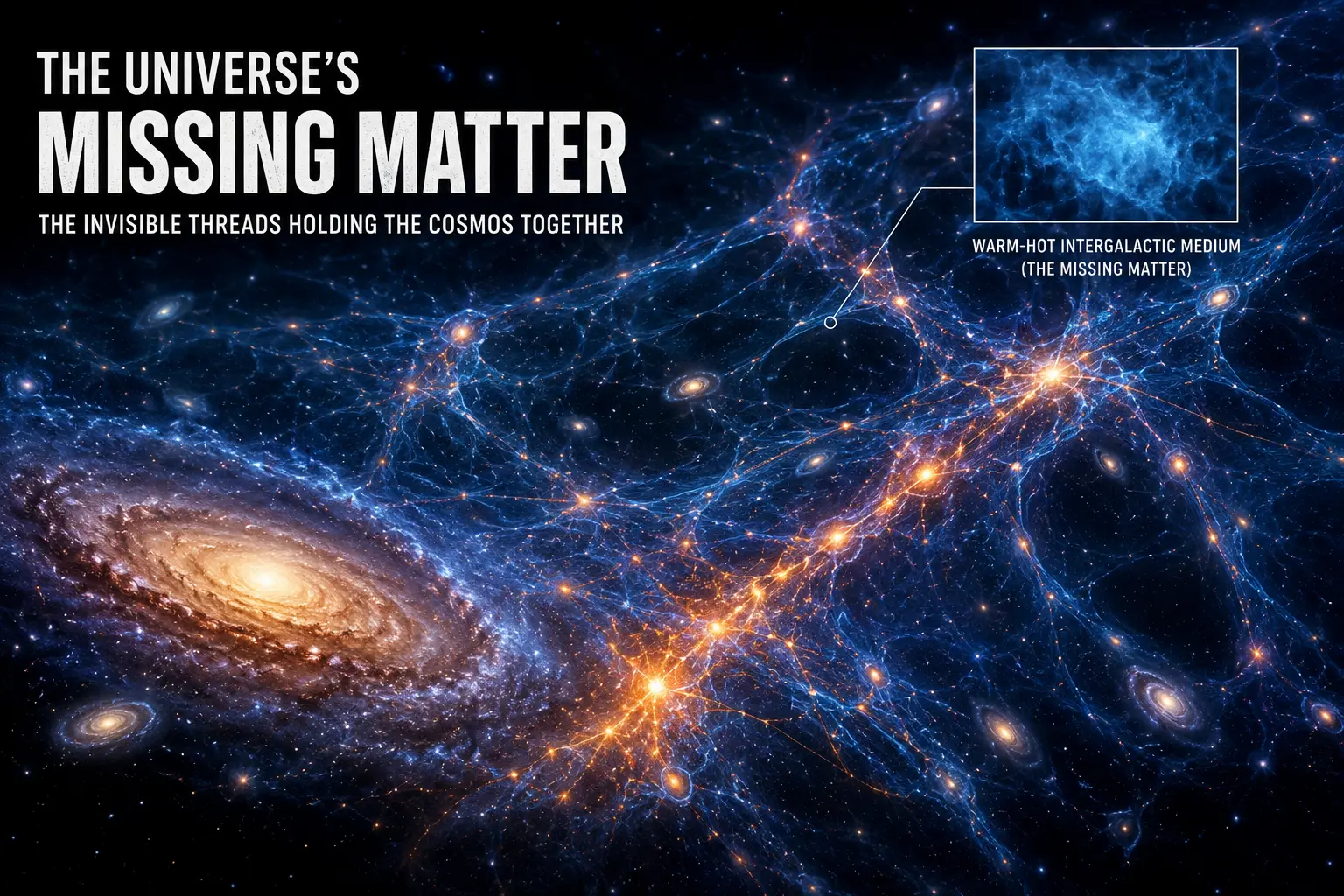
One of the biggest breakthroughs came from studying something called the cosmic web.
The universe isn’t randomly scattered.
Instead, galaxies are connected through enormous filaments stretching across hundreds of millions of light-years.
These gigantic structures resemble an invisible spider web on the largest scales imaginable.
Galaxies gather where these filaments intersect, while vast empty regions called cosmic voids separate them.
Scientists suspected these filaments might contain the missing matter.
But proving it was another challenge entirely.
A Nearly Invisible Gas
Researchers discovered that much of the missing matter exists as an extremely hot, incredibly thin gas.
Known as the Warm-Hot Intergalactic Medium (WHIM), this gas reaches temperatures between hundreds of thousands and millions of degrees Celsius.
Despite being unbelievably hot, it remains nearly invisible because it is also extraordinarily diffuse.
Even advanced telescopes struggle to detect it directly.
Only by observing distant quasars—brilliant galaxies powered by supermassive black holes—could scientists see tiny fingerprints left by this hidden gas as light passed through it.
Those faint signals became the first convincing evidence that the missing matter had finally been found.
Why Is It So Hard to Detect?
Space is far emptier than most people imagine.
Even regions filled with the WHIM contain only a handful of particles per cubic meter.
That’s a much better vacuum than scientists can create in laboratories on Earth.
Because these particles are spread over unimaginable distances, they produce only incredibly weak signals.
Finding them required:
- X-ray observatories
- Radio telescopes
- Ultraviolet spectroscopy
- Supercomputer simulations
- Years of international collaboration
Each new observation slowly filled in another piece of the puzzle.
New Discoveries Continue to Strengthen the Case
Recent observations have continued to support the idea that the missing matter lies between galaxies rather than inside them.
Fast Radio Bursts (FRBs)—brief but incredibly powerful flashes of radio waves from distant galaxies—have become one of astronomy’s newest investigative tools.
As these bursts travel across billions of light-years, they pass through intergalactic gas.
The gas slightly delays different radio frequencies, allowing scientists to estimate how much matter exists along the burst’s journey.
This clever technique has provided independent evidence that the universe’s missing ordinary matter is indeed spread throughout the cosmic web.
Every new FRB helps researchers map the invisible universe with greater precision.
Why This Discovery Matters
Finding the missing matter isn’t simply about checking off an item on a scientific list.
It helps answer much bigger questions.
Understanding where ordinary matter exists improves models of:
- Galaxy formation
- Star birth
- Black hole evolution
- Cosmic expansion
- The large-scale structure of the universe
It also confirms decades of theoretical predictions that had remained frustratingly unverified.
When observations finally match the mathematics, scientists gain greater confidence in our understanding of how the universe evolved after the Big Bang.
What About Dark Matter?
It’s important not to confuse missing ordinary matter with dark matter.
Dark matter remains one of science’s greatest mysteries.
Scientists believe dark matter makes up roughly 85% of all matter in the universe, yet nobody knows what it actually is.
The recently located missing matter represents only the ordinary matter that calculations already predicted should exist.
In other words:
Scientists have likely found the universe’s missing ordinary matter.
The search for dark matter continues.
The Future of the Search
The coming decade promises even more exciting discoveries.
New observatories, including next-generation X-ray telescopes and the world’s largest radio arrays, will map the cosmic web in unprecedented detail.
Thousands of additional Fast Radio Bursts are expected to reveal where ordinary matter flows between galaxies.
Artificial intelligence is also helping researchers analyze enormous datasets that would once have taken decades to study.
The result may be the most detailed map of the invisible universe ever created.
A Universe That Still Loves Secrets
The story of the missing matter reminds us that even after centuries of scientific progress, the universe continues to surprise us.
What once seemed like a glaring contradiction has gradually become a triumph of persistence, technology, and human curiosity.
Rather than disappearing, the universe simply hid much of its ordinary matter in places that were extraordinarily difficult to observe.
Every new telescope peels back another layer of the cosmos, revealing that reality is often stranger—and far more beautiful—than we imagined.
The mystery of the missing matter may be nearing its solution, but countless other cosmic puzzles are still waiting to be uncovered.
And that may be the most exciting discovery of all.
Frequently Asked Questions (FAQs)
What is the missing matter in the universe?
The missing matter refers to ordinary (baryonic) matter predicted by cosmological models but not initially detected through observations. Scientists now believe most of it exists as hot, diffuse gas between galaxies.
Is missing matter the same as dark matter?
No. Missing matter is normal matter made of protons, neutrons, and electrons. Dark matter is an unknown substance that interacts primarily through gravity and remains one of astronomy’s greatest mysteries.
How did scientists find the missing matter?
Researchers used X-ray observations, ultraviolet spectroscopy, and Fast Radio Bursts (FRBs) to detect extremely thin gas spread throughout the cosmic web.
Why couldn’t scientists see it before?
The gas is incredibly diffuse, with very few particles spread across enormous distances, making it extremely difficult for telescopes to detect.
Has the mystery been completely solved?
Scientists now have strong evidence explaining where most of the missing ordinary matter resides, although researchers continue refining their measurements and mapping the cosmic web in greater detail.


