

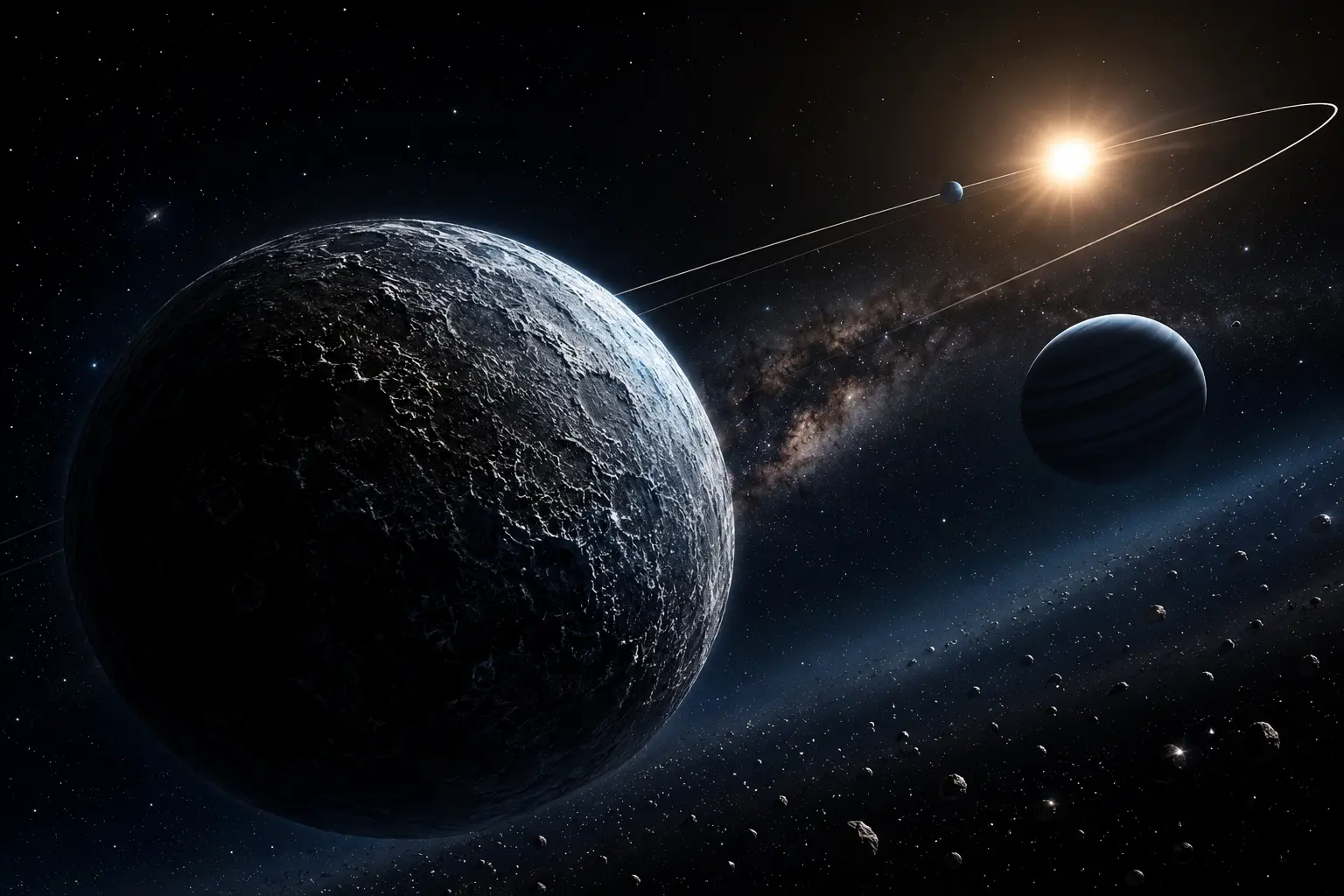
Scientists continue to push the boundaries of our understanding of the Solar System, and the latest discovery beyond Neptune has astronomers around the world asking new questions. A recently identified distant object orbiting far beyond the eighth planet is unlike many seen before. While researchers are still studying its origins, the finding could reshape how we think about the outer reaches of our cosmic neighborhood.
A New Mystery in the Outer Solar System
For decades, scientists believed they had a fairly good understanding of the Solar System. Beyond Neptune lies the Kuiper Belt, a vast region filled with icy worlds, dwarf planets, and frozen debris left over from the birth of the Solar System around 4.6 billion years ago.
But every few years, astronomers discover something that challenges those assumptions.
The latest object spotted beyond Neptune appears to have an unusual orbit that doesn’t fit neatly into current models. Instead of following the predictable paths seen in many distant icy bodies, this object travels along an elongated route that has scientists wondering whether an unseen force—or perhaps an undiscovered planet—may be influencing its motion.
While researchers are being cautious about drawing conclusions, the discovery is already generating excitement throughout the astronomy community.
Why This Discovery Is Different
Astronomers discover objects beyond Neptune fairly regularly thanks to increasingly powerful telescopes. What makes this finding stand out is not simply its distance from the Sun, but the way it moves through space.
Its orbit suggests it may have experienced gravitational interactions unlike those affecting most known Kuiper Belt objects.
That raises several fascinating possibilities:
- It could be a relic from the earliest days of the Solar System.
- It may have been pushed into its current orbit by a giant planet long ago.
- It could offer indirect evidence supporting the existence of the long-hypothesized Planet Nine.
- Or it may point to physical processes scientists have not yet fully understood.
Each possibility carries significant scientific implications.
The Planet Nine Question Returns
One of the most intriguing ideas is that this mysterious object’s orbit may add another piece to the Planet Nine puzzle.
Planet Nine is a hypothetical giant planet believed by some astronomers to exist far beyond Neptune. The theory emerged after researchers noticed that several extremely distant objects appeared to share unusual orbital patterns.
Although no telescope has directly detected Planet Nine, new discoveries like this keep the debate alive.
Scientists emphasize that one object alone cannot confirm the planet’s existence. However, every newly discovered distant object provides additional data that helps researchers test their models.
Whether Planet Nine exists or not, the search itself is improving our understanding of the Solar System’s outer frontier.
A Window Into the Solar System’s Past
Objects beyond Neptune are often described as cosmic time capsules.
Unlike Earth, where weather, volcanoes, oceans, and tectonic activity constantly reshape the surface, many distant icy worlds have remained largely unchanged for billions of years.
Studying them allows scientists to investigate what conditions were like shortly after the Solar System formed.
The newly discovered object could preserve valuable clues about how the giant planets migrated early in their history and how smaller bodies were scattered into the distant regions we observe today.
In many ways, these frozen worlds act like archaeological artifacts floating through space.
Better Telescopes Are Changing Everything
This discovery is also a reminder of how rapidly astronomy is advancing.
Modern observatories can detect objects that would have been completely invisible just a decade ago.
New surveys are mapping larger areas of the night sky with greater sensitivity, allowing astronomers to find smaller and more distant objects than ever before.
The world’s largest astronomical camera, installed at the Vera C. Rubin Observatory, is expected to accelerate discoveries dramatically in the coming years. Scientists anticipate it could reveal thousands of previously unknown objects in the outer Solar System, potentially solving long-standing mysteries while creating entirely new ones.
Why It Matters Beyond Astronomy
At first glance, finding another icy object billions of kilometers away might seem like an obscure scientific achievement.
In reality, discoveries like this influence many areas of science.
They help improve computer models of planetary formation, refine our understanding of gravity, and provide insights into how planetary systems develop around other stars.
Every new object discovered beyond Neptune becomes another piece of a much larger puzzle.
As astronomers study distant solar systems throughout the Milky Way, understanding our own Solar System remains the best starting point.
The Questions Scientists Still Need to Answer
Despite the excitement, researchers are careful not to overstate what they know.
Several important questions remain:
- How large is the object?
- What is it made of?
- Has its orbit always looked this way?
- Is another massive body influencing its motion?
- Are there many more objects like it waiting to be discovered?
Answering these questions will require years of additional observations using some of the world’s most advanced telescopes.
Science often moves slowly, but each observation brings us closer to understanding the bigger picture.
A Reminder That the Solar System Is Still Full of Surprises
Many people assume the Solar System has already been fully explored.
The truth is quite the opposite.
The region beyond Neptune remains one of the least understood parts of our cosmic neighborhood. Countless icy worlds almost certainly remain undiscovered, and every new finding reminds us that our maps of the outer Solar System are still incomplete.
History has shown that seemingly small discoveries can lead to major breakthroughs.
The discovery of Pluto transformed planetary science. The identification of the Kuiper Belt changed our understanding of the Solar System’s structure. Future discoveries beyond Neptune could prove just as important.
Looking Ahead
Astronomers expect the pace of discovery to increase significantly over the next decade.
Powerful telescopes, improved computing, and artificial intelligence are helping scientists detect faint objects that previously escaped notice.
Whether this newly identified object ultimately supports the Planet Nine hypothesis, reveals an entirely new class of distant worlds, or simply adds another chapter to our understanding of the Solar System, one thing is clear: space still holds countless mysteries.
Every time scientists look deeper into the darkness beyond Neptune, they uncover fresh evidence that our cosmic neighborhood is far more complex than once imagined.
The next great discovery may already be waiting in the cold, distant reaches of the Solar System—hidden in plain sight.
Frequently Asked Questions
What lies beyond Neptune?
Beyond Neptune are the Kuiper Belt, scattered disc objects, dwarf planets such as Pluto, and the distant Oort Cloud, which is believed to surround the Solar System.
What is Planet Nine?
Planet Nine is a proposed large planet that some astronomers believe may exist far beyond Neptune based on the unusual orbits of several distant objects. It has not yet been directly observed.
Why are distant objects important?
These ancient icy bodies preserve clues about how the Solar System formed and evolved billions of years ago.
Could there be more unknown planets?
Yes. Scientists continue to search for undiscovered objects in the outer Solar System using increasingly powerful telescopes and sky surveys.


