

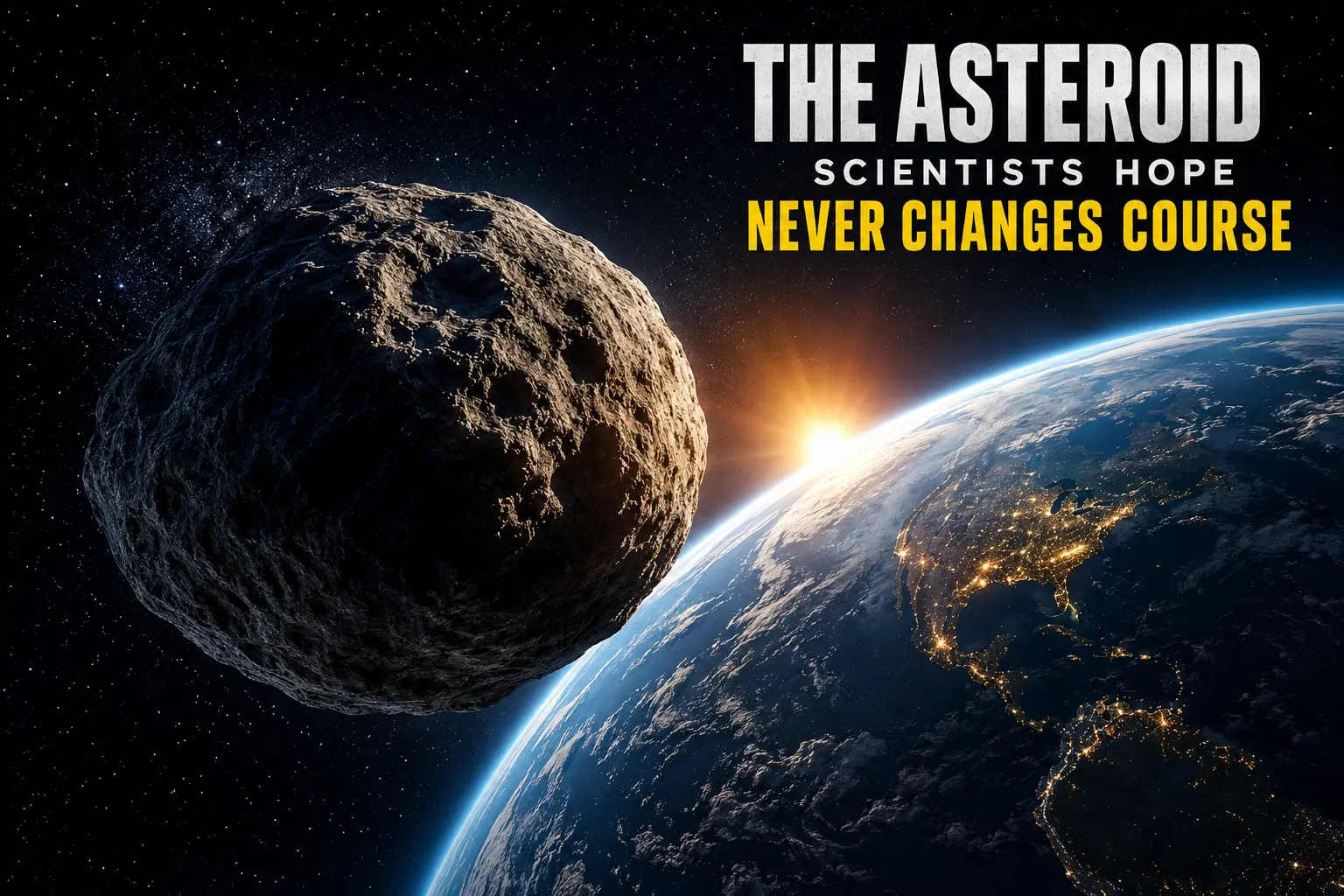
The night sky is filled with millions of asteroids silently orbiting the Sun. Most of them remain far from Earth, following predictable paths that astronomers have tracked for decades. But among these countless space rocks are a handful whose future movements matter more than most.
One asteroid, in particular, has earned unusual attention—not because it’s currently heading toward Earth, but because scientists desperately hope it never changes course.
That asteroid is 99942 Apophis.
For years, Apophis captured headlines after early calculations suggested it might collide with Earth. Improved observations later ruled out those frightening scenarios for at least the next century. Yet researchers continue watching it with extraordinary precision because even tiny changes in its orbit could alter its future encounters with our planet.
Apophis serves as a reminder that space is constantly changing, and even objects following stable paths today deserve careful observation.
A Space Rock That Once Terrified Scientists
When astronomers discovered Apophis in June 2004, they quickly realized it wasn’t just another asteroid.
Initial calculations showed an unusually high probability of an Earth impact in 2029. While those estimates were based on limited data and later proved incorrect, they were serious enough to trigger global attention within the planetary defense community.
As more observations poured in, scientists refined the asteroid’s orbit and eliminated the possibility of a collision during its famous 2029 flyby.
That was welcome news.
But Apophis wasn’t forgotten.
Instead, it became one of the most carefully monitored asteroids ever discovered.
The Historic Flyby in 2029
On April 13, 2029, Apophis will pass astonishingly close to Earth.
It will come within roughly 32,000 kilometers (20,000 miles) of Earth’s surface—closer than many geostationary satellites.
From several parts of the world, people will actually be able to see the asteroid with the naked eye as it races across the night sky.
Events like this are incredibly rare.
For astronomers, the flyby represents a once-in-a-lifetime scientific opportunity to study an asteroid up close without launching an expensive mission.
For everyone else, it’s a spectacular reminder that Earth shares its neighborhood with countless wandering objects.
Why Scientists Want Its Orbit to Stay Exactly the Same
The concern isn’t about Apophis today.
It’s about tomorrow.
Asteroids travel through a gravitational dance involving the Sun, planets, and even other asteroids. Every close encounter can slightly alter an asteroid’s path.
Think of it like a billiard ball that receives tiny nudges every time it passes another object.
Most of these changes are insignificant.
But over decades or centuries, those tiny adjustments can accumulate.
Scientists hope Apophis continues following the predictable orbit they’ve calculated because a stable orbit allows accurate long-term forecasting.
An unexpected change could require researchers to completely reevaluate future Earth encounters.
The Invisible Force That Can Change Everything
Gravity isn’t the only factor affecting asteroid motion.
There’s another phenomenon called the Yarkovsky Effect.
It sounds complicated, but the idea is surprisingly simple.
During the day, sunlight heats an asteroid.
At night, that heat radiates back into space.
Those escaping infrared photons create an incredibly tiny push.
The force is almost unimaginably small.
Yet after millions of rotations and years of orbiting the Sun, those microscopic pushes can gradually shift an asteroid’s trajectory.
Scientists have measured this effect on several near-Earth asteroids, making it an important factor in long-term predictions.
Earth’s Gravity Will Slightly Change Apophis Forever
Ironically, Earth’s own gravity will reshape Apophis’ orbit during the 2029 encounter.
The asteroid won’t strike Earth.
Instead, our planet’s gravitational pull will bend its path around the Sun.
Researchers already know this will happen.
The challenge is determining exactly how much the orbit changes afterward.
Even extremely small differences can influence where the asteroid will be decades into the future.
That’s why observatories worldwide are preparing years in advance.
The 2029 flyby will provide some of the best orbital measurements ever collected for a near-Earth asteroid.
Why Small Changes Matter So Much
Imagine throwing a paper airplane.
If you change its launch angle by just one degree, it might land several feet away from where you expected.
Now imagine that tiny change continuing for millions of kilometers through space.
Small differences become enormous over time.
That’s why planetary defense specialists measure asteroid positions with astonishing precision.
Sometimes they’re tracking objects whose future positions depend on measurements accurate to just a few meters across distances of hundreds of millions of kilometers.
It sounds almost impossible.
Yet modern astronomy accomplishes exactly that.
Could Another Asteroid Knock Apophis Off Course?
In theory, yes.
In practice, it’s extremely unlikely.
The asteroid belt is vast.
Despite containing millions of objects, collisions between large asteroids are relatively rare.
Still, astronomers include these possibilities when modeling asteroid populations over very long timescales.
Even passing relatively close to another asteroid can slightly alter an orbit through gravity alone.
That’s another reason continuous observation remains important.
Space isn’t static.
It’s constantly evolving.
Why Apophis Is Helping Protect Earth
Interestingly, Apophis has become one of humanity’s greatest teachers.
Because scientists know so much about it, the asteroid serves as a natural laboratory for improving planetary defense.
Researchers use it to test:
- Advanced orbit prediction software
- Radar observation techniques
- Telescope tracking methods
- International data sharing systems
- Emergency response planning
- Impact probability calculations
The lessons learned from Apophis could one day help humanity respond more effectively if another asteroid presents a genuine threat.
The Rise of Planetary Defense
Just a few decades ago, asteroid detection was relatively limited.
Today, the situation has changed dramatically.
Dedicated surveys continuously scan the skies for potentially hazardous objects.
Artificial intelligence now helps identify moving objects faster than ever before.
Space agencies are also developing technologies that could alter an asteroid’s path if one were ever found on a collision course with Earth.
NASA’s successful DART mission demonstrated that a spacecraft can deliberately change the orbit of an asteroid by crashing into it.
That achievement transformed planetary defense from theory into reality.
The New Generation of Asteroid Hunters
The coming years promise an explosion in asteroid discoveries.
New observatories, including the Vera C. Rubin Observatory, are expected to detect millions of previously unknown Solar System objects.
Many won’t pose any danger.
But every new discovery improves our understanding of Earth’s cosmic neighborhood.
The more asteroids scientists catalog, the fewer surprises remain.
That knowledge is one of our best defenses.
What If Apophis Ever Did Change Course?
At present, there is no confirmed impact threat from Apophis for at least the next century based on current orbital calculations.
However, scientists routinely update asteroid orbits whenever new observations become available.
If future measurements ever indicated a meaningful increase in impact probability, the global scientific community would know years—likely decades—in advance.
That advance warning is crucial.
Modern planetary defense strategies rely on early detection.
Changing an asteroid’s orbit by only a tiny amount years before a possible impact is far easier than trying to stop it at the last moment.
Fortunately, Apophis remains an object of scientific interest rather than immediate concern.
Why Watching the Sky Never Stops
Every clear night, telescopes around the world quietly scan the heavens.
Most of what they find poses no danger.
Yet the universe is dynamic.
Comets appear unexpectedly.
Asteroids are discovered every week.
Existing orbits become more accurate as fresh observations arrive.
This constant vigilance isn’t driven by fear.
It’s driven by preparation.
Scientists know that understanding our cosmic surroundings is one of the best ways to ensure Earth’s long-term safety.
The Bigger Picture
Apophis represents something larger than a single asteroid.
It symbolizes humanity’s growing ability to understand and predict events happening millions of kilometers away.
Just twenty years ago, an object like Apophis might have remained poorly understood.
Today, astronomers can forecast its future position with remarkable precision while continuously refining those predictions as new data becomes available.
That’s a remarkable scientific achievement.
Rather than fearing every asteroid, researchers now focus on careful observation, improved technology, and international cooperation.
Their goal isn’t simply to predict the future.
It’s to ensure that if a real threat ever emerges, humanity will have time to respond.
For now, Apophis remains exactly where scientists want it to be—following a well-understood path through the Solar System.
And that’s one course everyone hopes never changes.


amazing
Thank you so much 😊
i enjoyed reading all these stories these Cosmic stories are very intersting and Amazing Informative
Thank you so much 😊