

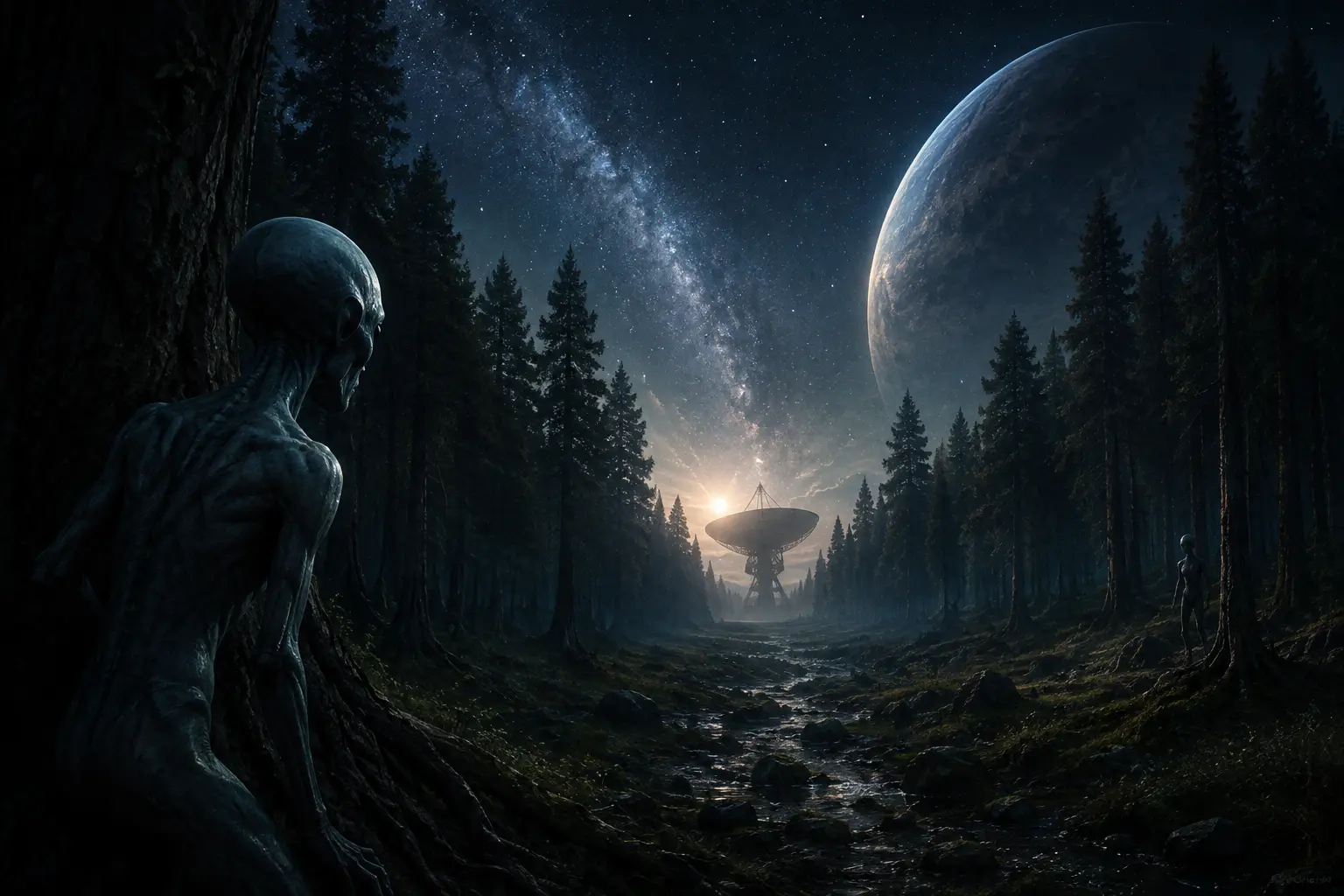
A Chilling Answer to One of Humanity’s Biggest Questions
For decades, scientists, astronomers, and science-fiction writers have wrestled with a simple but profound question: if the universe is so vast and so old, where is everybody?
The Milky Way alone contains hundreds of billions of stars, many of which are believed to host planets. Modern astronomical discoveries have revealed thousands of exoplanets, strengthening the possibility that life could exist elsewhere in the cosmos. Yet despite decades of searching, humanity has found no confirmed evidence of intelligent extraterrestrial civilizations.
This puzzle is known as the Fermi Paradox, named after physicist Enrico Fermi, who famously questioned why humanity has not encountered alien life despite the apparent likelihood that it should exist. Among the many proposed explanations, one stands out for its sheer bleakness and psychological impact: the Dark Forest Theory.
The theory suggests that the universe may be filled with intelligent civilizations, but they remain silent for a terrifying reason. In this view, every civilization is hiding because revealing its location could invite destruction from a more advanced and potentially hostile species.
What Is the Dark Forest Theory?
The Dark Forest Theory gained widespread attention through Chinese science-fiction author Liu Cixin’s novel The Dark Forest, published in 2008 as part of the acclaimed Remembrance of Earth’s Past trilogy. Although the idea existed in various forms before the novel, Liu’s work popularized the concept and introduced it to a global audience.
The theory imagines the universe as a vast, dark forest. Every intelligent civilization is like an armed hunter moving silently through the trees. Because visibility is limited and intentions are impossible to verify across interstellar distances, each civilization must assume that others could pose a threat.
In such an environment, making your presence known becomes extremely dangerous. Broadcasting signals into space may be equivalent to shining a flashlight in a forest filled with unknown predators. The safest strategy is therefore silence.
According to the theory, civilizations that openly announce their existence may eventually be discovered and eliminated by stronger civilizations seeking to remove potential future threats. As a result, only the quiet civilizations survive long enough to become advanced.
The Connection to the Fermi Paradox
The Dark Forest Theory is often discussed as a potential solution to the Fermi Paradox.
The paradox arises because the universe is approximately 13.8 billion years old, while Earth and the Solar System are relatively young by comparison. Given this immense timescale, many scientists argue that intelligent civilizations could have emerged elsewhere millions or even billions of years before humanity. If such civilizations exist, why have we not seen evidence of them?
Traditional explanations include:
- Intelligent life is extremely rare.
- Civilizations destroy themselves before becoming interstellar.
- We have not searched long enough.
- Alien communication methods are beyond our understanding.
- Advanced civilizations choose not to contact us.
The Dark Forest Theory takes a more ominous position. It suggests that the silence itself is evidence of survival behavior. Civilizations are not absent; they are deliberately hiding.
Under this framework, the universe is not empty. Instead, it may be crowded with civilizations that have learned a dangerous lesson: speaking up can get you killed.
Why Would Aliens Fear Each Other?
At first glance, the theory may seem excessively pessimistic. Why assume that alien civilizations would be hostile?
Supporters of the Dark Forest concept point to several logical challenges associated with interstellar contact.
Survival Comes First
One of the theory’s central assumptions is that survival is the primary goal of every civilization. Whether on Earth or elsewhere, intelligent species would likely prioritize their continued existence.
If survival is the highest priority, then any unknown civilization becomes a potential risk.
Even if another species appears peaceful today, there is no guarantee it will remain peaceful in the future. Over centuries or millennia, technological capabilities can change dramatically.
The Problem of Trust
Communication across interstellar distances is incredibly slow. Messages may take decades, centuries, or even thousands of years to travel between civilizations.
As a result, establishing trust becomes nearly impossible.
Imagine receiving a message from an alien civilization located hundreds of light-years away. Even if the message appears friendly, how can you know their true intentions? By the time a response arrives, both civilizations could have evolved technologically and politically.
This uncertainty creates what some theorists describe as a “chain of suspicion,” where each civilization fears that the other may eventually become a threat.
Technological Explosions
Human history demonstrates how quickly technological progress can occur. In just over a century, humanity advanced from early flight to space exploration, nuclear weapons, and artificial intelligence.
If another civilization experiences a similar acceleration, a weaker society today could become a powerful competitor tomorrow.
From a purely strategic perspective, a civilization may decide that eliminating a potential future rival is safer than waiting to discover its intentions.
Could Humanity Already Be Broadcasting Its Location?
One aspect of the Dark Forest Theory that captures public imagination is its implication for Earth.
For more than a century, humanity has been transmitting radio signals into space. Television broadcasts, radar systems, military communications, and scientific transmissions have created a growing sphere of electromagnetic radiation expanding outward from Earth.
These signals have already traveled dozens of light-years into space.
Some researchers involved in the Search for Extraterrestrial Intelligence (SETI) have argued that actively sending messages to alien civilizations could increase the chances of making contact. Others have expressed caution, warning that humanity cannot predict how an unknown civilization might react.
The Dark Forest Theory amplifies these concerns dramatically.
If the theory is correct, every message humanity sends into the cosmos could be revealing our position to civilizations whose intentions are impossible to determine.
At present, however, there is no scientific evidence that Earth’s signals have attracted extraterrestrial attention.
What Does Science Say?
It is important to distinguish between scientific investigation and speculative theory.
The Dark Forest Theory is not an accepted scientific explanation for the Fermi Paradox. Instead, it is a philosophical and science-fiction-inspired hypothesis that explores how intelligent civilizations might behave under conditions of extreme uncertainty.
Astrobiologists and SETI researchers continue to investigate numerous possibilities regarding extraterrestrial life.
Some scientists argue that intelligent civilizations may simply be very rare. Others suggest that technological societies could have relatively short lifespans, reducing the likelihood of overlapping in time with humanity. Still others propose that alien civilizations might use communication methods we have not yet discovered.
There is currently no verified evidence supporting the claim that advanced civilizations are hiding or destroying one another. Likewise, there is no evidence disproving the possibility.
In scientific terms, the Dark Forest remains an intriguing thought experiment rather than a tested theory.
Why the Idea Resonates With People
Despite its speculative nature, the Dark Forest Theory has become one of the most widely discussed explanations for cosmic silence.
Part of its appeal lies in its psychological realism.
Human history contains countless examples of mistrust, competition, and conflict between societies encountering one another for the first time. Empires have expanded, resources have been contested, and technological advantages have often determined outcomes.
The Dark Forest Theory extends these historical patterns to a galactic scale.
It forces people to consider uncomfortable questions:
- Would humanity trust an alien civilization?
- Could two civilizations separated by hundreds of light-years ever truly understand one another?
- Is caution a rational response to uncertainty?
- Could fear itself be shaping the behavior of intelligent life across the universe?
These questions resonate because they reflect real challenges in diplomacy, security, and human nature.
The Criticisms of the Dark Forest Theory
Many experts remain skeptical of the theory’s assumptions.
Critics argue that the Dark Forest framework relies heavily on projecting human fears and strategic thinking onto unknown alien civilizations.
An extraterrestrial species may possess values, motivations, or social structures that are entirely unlike anything humans can imagine.
Others note that launching interstellar attacks would require enormous resources and technological capabilities. The practical challenges involved may make widespread preemptive warfare unlikely.
There is also the possibility that advanced civilizations recognize cooperation as more beneficial than conflict. If technological societies survive long enough to become interstellar, they may develop ethical systems that discourage aggressive expansion.
In this view, the universe’s silence could stem from reasons far less sinister than cosmic warfare.
The Lasting Legacy of the Dark Forest
Whether ultimately correct or not, the Dark Forest Theory has become one of the most influential ideas in modern discussions about extraterrestrial intelligence.
It transformed the Fermi Paradox from a scientific puzzle into a broader debate about survival, trust, and the nature of intelligence itself.
The theory’s enduring popularity reflects humanity’s fascination with the unknown. It challenges the optimistic assumption that advanced civilizations would automatically seek friendship or cooperation. Instead, it presents a universe shaped by caution, uncertainty, and self-preservation.
For now, the cosmos remains silent.
Astronomers continue scanning the skies for signs of intelligent life. Powerful telescopes search distant planets for evidence of habitability. Researchers listen for signals that might reveal another civilization somewhere among the stars.
Yet until definitive evidence emerges, the question remains unanswered.
Are we alone in the universe?
Or is the galaxy filled with silent civilizations, hiding among the cosmic trees, hoping that no one notices they are there?
The Dark Forest Theory suggests the latter possibility—and that is precisely what makes it one of the most unsettling ideas ever proposed about life beyond Earth.


