
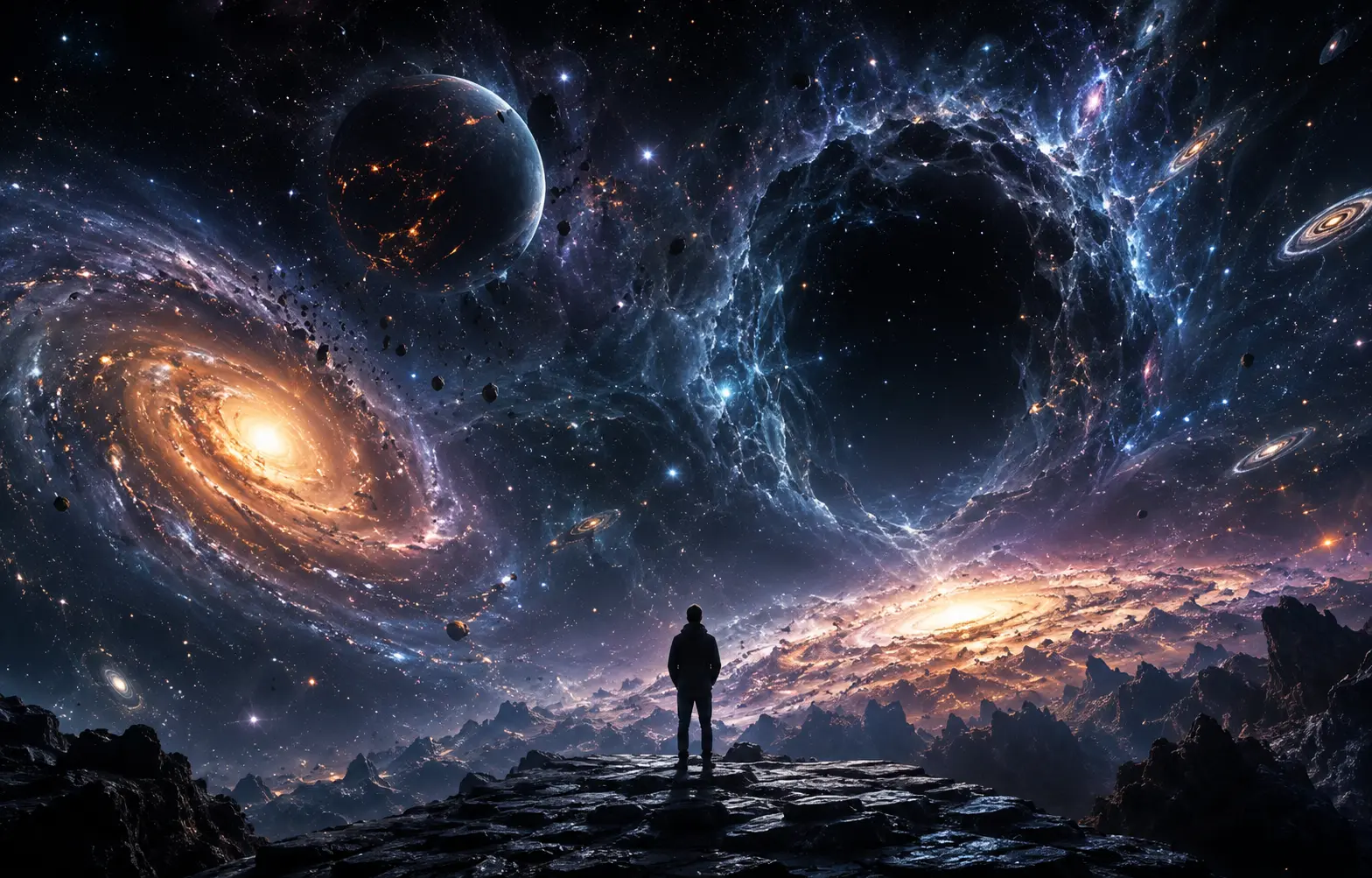
For centuries, humanity has looked up at the night sky and wondered what lies beyond. Ancient civilizations imagined gods, celestial kingdoms, and cosmic oceans. Modern science replaced myths with telescopes, satellites, and mathematical equations. Yet despite all our technological progress, one uncomfortable truth remains:
We still do not fully understand the universe.
In fact, the more scientists learn about the cosmos, the stranger it appears. Some of the most widely accepted theories suggest that reality itself may be far more mysterious—and in some cases far more frightening—than anything found in science fiction.
From invisible forms of matter that dominate the cosmos to the possibility that the laws of physics could suddenly change without warning, modern cosmology paints a picture of a universe that is both breathtaking and unsettling.
So what exactly makes the universe so strange? And why do some scientists believe its deepest mysteries could challenge everything we think we know about reality?
The First Shock: Most of the Universe Is Invisible
Imagine walking into a room and discovering that everything you can see represents only 5% of what’s actually there.
That is essentially the situation astronomers face today.
According to current cosmological models, ordinary matter—the stars, planets, galaxies, humans, animals, and everything visible—makes up only about 5% of the universe. The remaining 95% consists of two mysterious components known as dark matter and dark energy, neither of which has been directly observed.
Dark matter appears to provide extra gravity that holds galaxies together. Without it, many galaxies would spin so fast that they would fly apart.
Dark energy is even stranger. It seems to be causing the expansion of the universe to accelerate rather than slow down. Scientists know something is driving this acceleration, but they still do not know exactly what it is.
Think of it this way: if the universe were a book, humanity currently understands only a few pages while the rest remain unread.
That realization alone is enough to make the cosmos feel far stranger than it once did.
Dark Energy: The Force Nobody Understands
One of the greatest mysteries in modern science is dark energy.
When astronomers discovered in the late 1990s that the universe’s expansion was speeding up, it completely overturned expectations. Gravity should slow expansion over time, yet observations showed the opposite was happening.
Scientists gave this unknown phenomenon a name—dark energy—but naming something is not the same as understanding it.
Several explanations have been proposed:
- Energy inherent to empty space itself.
- A previously unknown cosmic field.
- A flaw in our understanding of gravity.
- An entirely new aspect of physics yet to be discovered.
Recent observations have even raised questions about whether dark energy behaves differently over time than previously thought. If confirmed, it could force scientists to revise major parts of the standard model of cosmology.
In other words, the force controlling the future of the universe remains largely unknown.
And that’s a little unsettling.
Cosmic Voids: The Universe’s Giant Empty Rooms
When most people picture space, they imagine galaxies scattered across the cosmos.
What they often don’t realize is that much of the universe consists of enormous regions called cosmic voids—vast stretches of space containing very few galaxies.
Some of these voids span hundreds of millions of light-years.
If the Milky Way were located near the center of one of these regions, the night sky could appear dramatically different. There would be fewer neighboring galaxies and a much lonelier cosmic landscape.
Scientists increasingly study these voids because they may reveal clues about dark energy, gravity, and the universe’s large-scale structure. Far from being empty, they may hold answers to some of cosmology’s biggest questions.
The irony is fascinating: sometimes the emptiest places in the universe may contain the most important secrets.
Could Reality Be Less Stable Than We Think?
Now we enter territory that sounds like science fiction but originates from real theoretical physics.
Some physicists have explored the possibility that our universe exists in what is called a false vacuum.
In simple terms, imagine a ball resting in a shallow valley. It appears stable, but there could be a deeper valley nearby. If the ball somehow falls into the lower valley, everything changes.
Certain quantum field theories suggest our universe could exist in a similar state. The vacuum of space may not represent the absolute lowest-energy state possible.
If a transition to a lower-energy state ever occurred, it could theoretically create a bubble expanding at the speed of light.
Inside that bubble, the fundamental constants of nature might be different. Atoms, chemistry, stars, and even life itself could no longer function in their current forms.
Before panic sets in, it is important to emphasize that this remains a theoretical possibility, not an observed phenomenon. Many physicists view it as highly speculative, and there is currently no evidence that such an event is imminent.
Still, the concept reveals just how strange modern physics can become when exploring the deepest layers of reality.
The Universe Might Not Even Work the Way We Think
Science thrives by questioning assumptions.
One assumption long accepted by cosmologists is that dark energy drives accelerated cosmic expansion.
However, some recent research has challenged whether that acceleration is occurring exactly as previously believed. Alternative interpretations of observational data suggest the story may be more complicated.
This does not mean dark energy has been disproven.
Rather, it highlights an important reality: cosmology is still evolving.
Many of today’s accepted ideas may eventually be refined, modified, or replaced as better data becomes available.
History offers countless examples.
Scientists once believed:
- Earth was the center of the universe.
- The Milky Way was the entire universe.
- The universe was static and unchanging.
Each assumption eventually proved incomplete.
There is no guarantee our current understanding will be the final answer.
What Happens at the End of the Universe?
Perhaps the most chilling question in cosmology is not how the universe began but how it will end.
Several possible scenarios exist.
The Big Freeze
The most widely discussed possibility is a gradual cosmic fading.
As the universe expands, galaxies drift farther apart. Star formation eventually slows. Existing stars burn out. Black holes evaporate over unimaginable timescales.
Eventually, the cosmos becomes cold, dark, and nearly empty.
The Big Rip
If dark energy grows stronger over time, expansion could accelerate dramatically.
In an extreme version of this scenario, galaxies, stars, planets, and eventually atoms themselves could be torn apart by the expansion of space.
Vacuum Decay
As discussed earlier, a transition to a lower-energy vacuum state could theoretically alter the laws of physics instantly across expanding regions of space.
None of these outcomes are expected anytime soon. We are talking about timescales measured in billions or trillions of years.
Yet their existence reminds us that the universe is dynamic rather than permanent.
Why These Mysteries Matter
It’s easy to dismiss these ideas as abstract thought experiments with little relevance to daily life.
But history suggests otherwise.
Research into fundamental physics has led to technologies that transformed civilization, including:
- GPS navigation.
- Medical imaging.
- Semiconductors.
- Nuclear energy.
- The internet’s underlying infrastructure.
Questions about dark matter, dark energy, gravity, and quantum fields may seem distant today. Yet understanding them could eventually unlock technologies we cannot currently imagine.
More importantly, these mysteries force humanity to confront profound questions:
- What is reality?
- Why does the universe exist?
- Are the laws of nature permanent?
- How much of existence remains hidden?
These are not merely scientific questions. They are philosophical questions that have fascinated humanity for thousands of years.
The Most Humbling Discovery of All
Perhaps the strangest realization is not that the universe contains dark matter, dark energy, cosmic voids, or theoretical vacuum decay.
Perhaps the strangest realization is how little we truly know.
Every major breakthrough in astronomy has revealed new layers of mystery rather than providing final answers.
The telescope showed that Earth was not the center of everything.
The discovery of galaxies revealed that the Milky Way was only one among billions.
Dark matter and dark energy showed that most of the universe is invisible.
And modern cosmology continues to suggest that reality may be far more complex than our current theories can explain.
The universe is not simply bigger than we imagined.
As the famous astronomer Sir Arthur Eddington once suggested, it may be stranger than we can imagine.
And that possibility may be the most fascinating—and frightening—discovery of all.
Final Thoughts
The cosmos remains one of humanity’s greatest mysteries. While science has uncovered remarkable insights into how the universe works, the biggest questions remain unanswered.
Dark matter dominates galaxies. Dark energy shapes cosmic expansion. Vast voids stretch across unimaginable distances. The ultimate fate of reality remains uncertain.
Rather than diminishing our place in the universe, these mysteries make our search for knowledge even more meaningful.
Because every new discovery reminds us that we are explorers standing on the shore of a cosmic ocean, still trying to understand what lies beyond the horizon.
And if modern physics is correct, what lies beyond may be stranger—and scarier—than we ever imagined.


