
For most of human history, time has felt like the one thing we could always count on.
Seconds become minutes. Days become years. Civilizations rise and fall. Stars are born, shine brightly, and eventually die. Everything in the universe appears to move forward on a grand cosmic clock.
But what if that clock is already winding down?
It sounds like science fiction, yet some of the most respected physicists and cosmologists have explored a disturbing possibility: the universe may already be heading toward a future where time itself loses meaning. In some theories, the countdown has already begun.
This isn’t a prediction that the world will end tomorrow. Instead, it is a profound scientific question about the ultimate fate of reality itself. If the laws of physics are correct, the universe may be moving toward a state where change becomes impossible, events stop occurring, and what we call “time” effectively runs out.
Why Time Exists in the First Place
Most people think of time as a constant flow, like a river moving endlessly forward.
Physics paints a different picture.
According to modern science, time is deeply connected to change. We measure time because things happen. Clocks tick. Planets orbit stars. Cells divide. People grow older.
Without change, time becomes difficult to define.
One of the key ideas behind this is entropy—a concept from thermodynamics that measures disorder in a system. Entropy tends to increase over time, giving the universe what scientists call an “arrow of time.” It is why eggs can be scrambled but never naturally unscrambled, and why yesterday cannot be revisited.
The increase of entropy is what allows us to distinguish the past from the future.
But what happens when entropy reaches its maximum possible value?
That question leads directly to one of the most unsettling theories in cosmology.
The Heat Death of the Universe
The leading scientific model for the universe’s distant future is known as the Heat Death, sometimes called the Big Freeze.
The idea is surprisingly simple.
The universe is expanding. In fact, observations show that this expansion is accelerating due to a mysterious force known as dark energy. As galaxies move farther apart, stars gradually exhaust their fuel, and the cosmos becomes increasingly cold and empty.
Imagine a campfire.
At first, it burns brightly with intense heat and light. Eventually, the wood is consumed. The flames disappear. Only cold ashes remain.
According to the Heat Death theory, the universe is following a similar path—but on a scale almost impossible to comprehend.
Over unimaginable spans of time:
- Stars stop forming.
- Existing stars burn out.
- Galaxies grow dark.
- Black holes slowly evaporate.
- Matter itself may decay.
Eventually, all usable energy becomes evenly distributed across space. No energy gradients remain. Nothing can power motion, chemistry, life, or even information processing.
The universe does not explode.
It simply fades away.
When Nothing Happens Anymore
This is where things become truly eerie.
In the Heat Death scenario, the universe doesn’t disappear.
Space still exists.
Particles may still exist.
Energy still exists.
But nothing meaningful can happen.
Think about a battery.
A fully charged battery can power a device because there is a difference between its positive and negative terminals. Once that energy becomes evenly distributed, the battery is “dead.”
The universe may face the same fate.
As one popular explanation describes it, energy doesn’t vanish—it simply becomes unusable because there is nowhere left for it to flow.
Without energy differences, no processes can occur.
No stars.
No planets.
No life.
No memories.
No new events.
In a sense, time continues mathematically, but there is nothing left to measure its passage.
This has led some physicists and philosophers to argue that time itself effectively ends.
Could Time Already Be Running Out?
The title may sound dramatic, but there is a scientific reason behind it.
If Heat Death is indeed the universe’s destiny, then the process has already begun.
Every star that exhausts its fuel.
Every galaxy drifting farther away.
Every increase in entropy.
These are tiny steps toward that ultimate state.
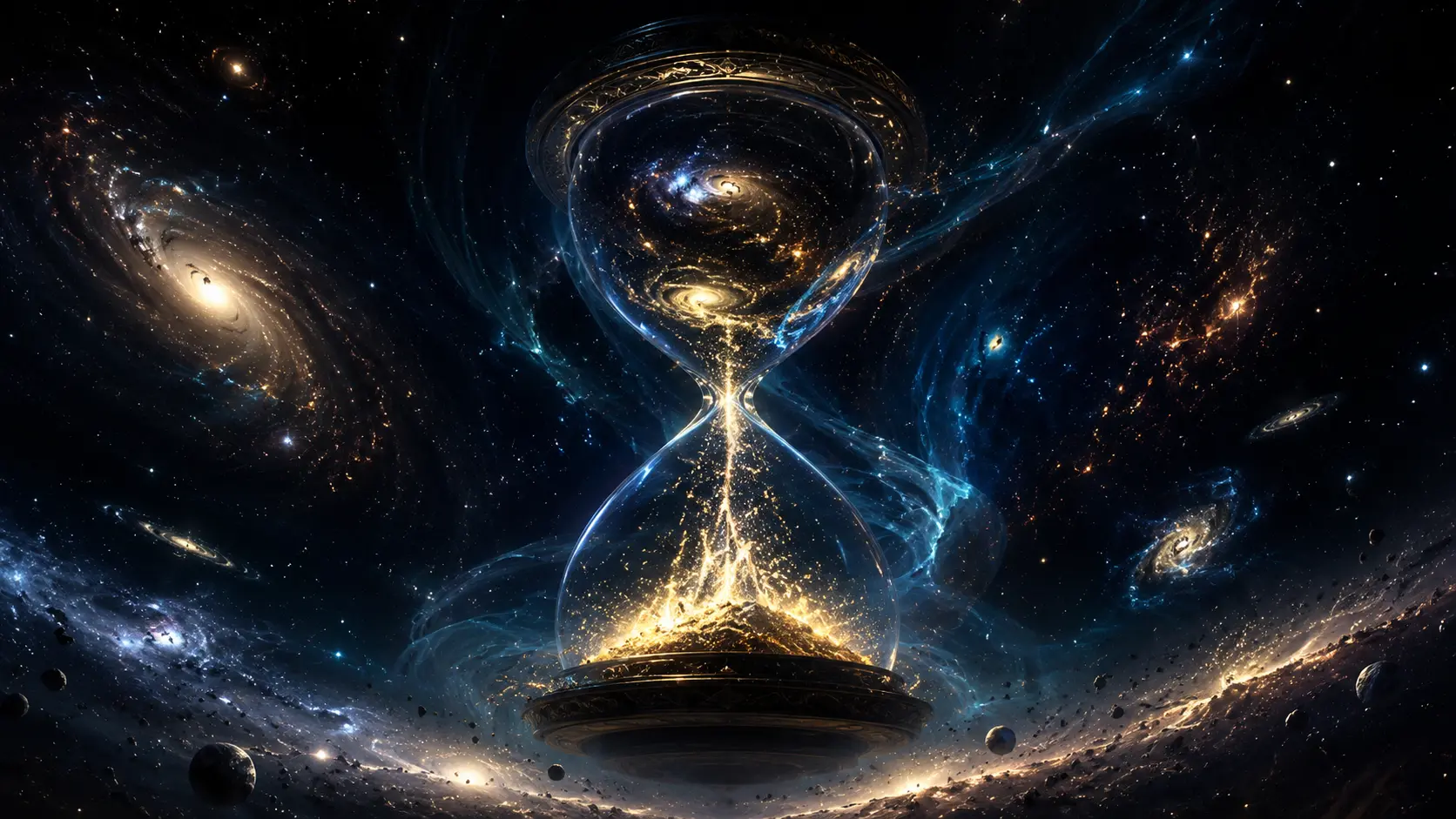
Imagine watching a massive hourglass.
When it is nearly full, the falling grains seem insignificant.
Yet the countdown started the moment the first grain moved.
Similarly, if the universe is heading toward maximum entropy, then the clock has been ticking since the Big Bang itself.
Some scientists describe the entire history of the cosmos as a gradual journey toward equilibrium. The universe may currently be in its vibrant middle age, but the long-term trend appears clear: increasing disorder and decreasing opportunities for complexity.
The Even More Frightening Theory: Vacuum Decay
As unsettling as Heat Death sounds, another theory may be even more terrifying.
It is called Vacuum Decay.
In quantum physics, empty space isn’t truly empty. Space itself possesses energy, known as vacuum energy.
Some researchers have suggested that our universe may currently exist in a “false vacuum”—a stable-looking state that isn’t actually the lowest possible energy state.
A useful analogy is a ball resting in a shallow valley.
The ball appears stable.
But if a deeper valley exists nearby, a disturbance could cause it to roll downward.
If our universe occupies a false vacuum, a transition to a lower-energy state could theoretically occur.
The consequences would be catastrophic.
A bubble of true vacuum would expand outward at the speed of light, rewriting the laws of physics wherever it passed. Atoms, molecules, stars, planets, and life itself would cease to exist as we know them.
The most disturbing part?
We would never see it coming.
Because the bubble travels at light speed, there would be no warning.
One moment everything exists.
The next moment it doesn’t.
Fortunately, there is currently no evidence that such an event is imminent. It remains a theoretical possibility rather than an observed threat.
Dark Energy’s Mysterious Role
The biggest unknown in all of these discussions is dark energy.
Dark energy appears to make up most of the universe’s total energy content, yet scientists still do not know exactly what it is.
Recent observations have raised intriguing questions about whether dark energy might change over time rather than remain constant. If true, the universe’s future could look very different from current predictions.
Some possibilities include:
The Big Crunch
Instead of expanding forever, the universe could eventually stop expanding and begin collapsing inward.
Galaxies would move closer together.
Temperatures would rise.
The cosmos could ultimately collapse into an incredibly dense state.
The Big Rip
If dark energy becomes stronger over time, expansion could accelerate dramatically.
Galaxies would separate.
Solar systems would break apart.
Eventually, even atoms might be torn apart by cosmic expansion.
Cyclic Universes
Some models propose that the universe undergoes endless cycles of expansion and contraction.
In this scenario, an ending might simply become a new beginning.
Scientists continue to study these possibilities because understanding dark energy may reveal the ultimate fate of reality itself.
What This Means for Humanity
The good news is that none of these scenarios pose an immediate danger.
Even the most dramatic cosmological endings occur on timescales measured in billions, trillions, or vastly greater numbers of years.
Human civilization faces far more pressing challenges in the near future.
Yet these theories remain important because they force us to confront profound questions:
- Why does the universe exist?
- Why does time move forward?
- Is the cosmos eternal?
- Can reality itself end?
These aren’t merely scientific curiosities.
They touch on philosophy, existence, and humanity’s place in the cosmos.
The Ultimate Countdown
The idea that time might already be running out is not a prediction of imminent doom.
It is a reflection of what modern physics tells us about the universe’s long-term future.
Whether the cosmos ends in a cold Heat Death, a sudden Vacuum Decay event, a catastrophic Big Rip, or an eventual Big Crunch remains uncertain. Scientists are still gathering data and refining their models.
What seems increasingly clear is that the universe is not static.
It is evolving.
And every moment that passes moves it one step further along its cosmic journey.
Perhaps the most chilling realization is not that time could end someday.
It is that the process may have begun 13.8 billion years ago, with the birth of the universe itself.
Since then, the cosmic clock has never stopped ticking.
The only question is how much time remains before the final page of the universe’s story is written.


