

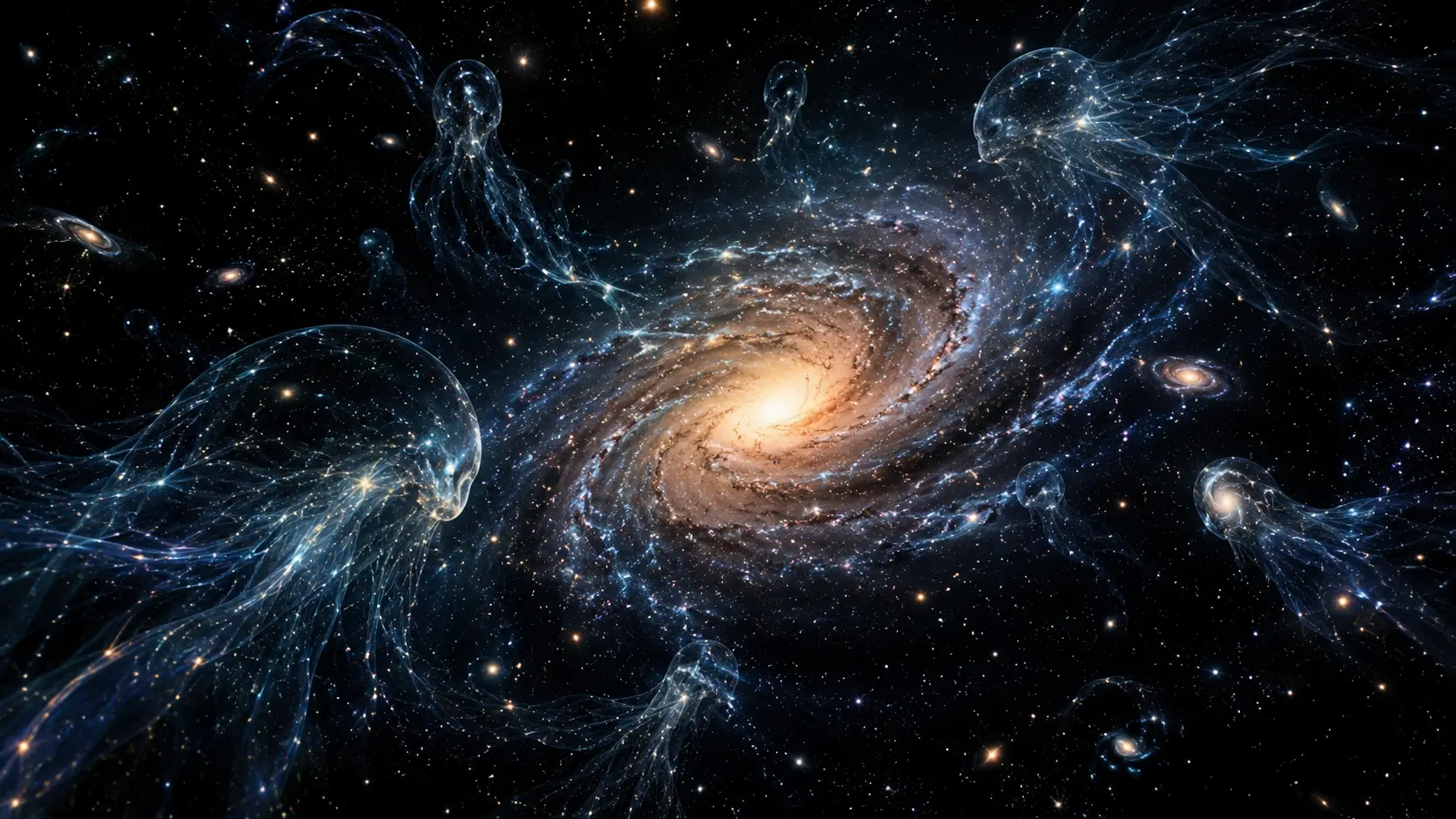
For decades, scientists have been searching for one of the universe’s greatest missing pieces.
It doesn’t shine. It doesn’t reflect light. It doesn’t emit radio signals. We can’t touch it, photograph it, or collect it in a laboratory. Yet astronomers believe it makes up about 85% of all matter in the universe.
It’s called dark matter, and without it, galaxies as we know them shouldn’t exist.
But what if dark matter isn’t merely an invisible substance?
What if it is something far stranger?
What if dark matter is actually a form of life—one so fundamentally different from us that we have failed to recognize its existence?
It sounds like science fiction, but the question touches on a serious scientific challenge: we still don’t know what dark matter actually is.
And whenever science encounters a mystery this large, some of the most fascinating possibilities emerge.
First, What Exactly Is Dark Matter?
Before exploring the idea of dark matter life, we need to understand why dark matter was proposed in the first place.
When astronomers observe galaxies, they can estimate how much matter exists by measuring stars, gas clouds, dust, planets, and other visible objects.
However, when they calculate how fast galaxies rotate, something doesn’t add up.
The visible matter simply isn’t enough to produce the gravitational effects being observed.
Galaxies should fly apart.
Instead, something invisible appears to be holding them together.
The same phenomenon appears in galaxy clusters, gravitational lensing events, and large-scale cosmic structures.
The conclusion reached by most cosmologists is that an enormous amount of unseen matter exists throughout the universe.
This mysterious material does not appear to interact strongly with light, which is why it remains invisible.
Scientists call it dark matter.
Yet despite decades of research, no one has definitively identified what it is.
The Biggest Mystery: We Have Never Seen Dark Matter Directly
This is where things become interesting.
Dark matter is not merely difficult to study.
It is almost completely hidden from us.
We infer its existence through gravity.
Imagine walking through a forest and seeing trees bend, leaves move, and branches shake, but never seeing the creature causing it.
You know something is there.
You just don’t know what.
Dark matter presents a similar challenge.
Scientists have proposed numerous candidates:
- Weakly Interacting Massive Particles (WIMPs)
- Axions
- Sterile neutrinos
- Primordial black holes
- Other exotic particles
So far, none has been conclusively detected.
That leaves an intriguing possibility open:
Could dark matter be something far more complex than a simple particle?
What Makes Something Alive?
To answer this question, we need to rethink what life actually means.
On Earth, life shares several characteristics:
- It stores information
- It responds to its environment
- It evolves
- It reproduces
- It maintains internal organization
Notice something important.
None of these requirements say life must be made from carbon.
None require DNA.
None require water.
These are simply features of life as we know it.
The universe may not be limited to the biological blueprint found on Earth.
If life can emerge under radically different conditions, then it becomes possible to imagine forms of existence that are almost unrecognizable to us.
Life We Literally Cannot See
Human beings evolved to perceive a tiny slice of reality.
Our eyes detect only visible light.
Our ears hear only a narrow range of frequencies.
Even our most advanced instruments reveal only portions of the universe.
History repeatedly shows that reality is larger than our senses.
Bacteria existed long before microscopes.
Radio waves existed before radio receivers.
Exoplanets existed before telescopes could detect them.
The fact that we cannot see something does not mean it isn’t there.
Dark matter already demonstrates this principle.
It appears to influence galaxies while remaining effectively invisible.
This naturally raises a provocative question:
Could dark matter possess structure, complexity, and perhaps even behavior that resembles life?
The Dark Matter Life Hypothesis
To be clear, there is currently no evidence that dark matter is alive.
This idea remains speculative.
However, scientists and philosophers have occasionally explored the possibility that life might exist in forms dramatically different from familiar biology.
Imagine a universe containing two parallel ecosystems.
The first is the ordinary matter universe—the one containing stars, planets, oceans, animals, and humans.
The second is a dark matter universe.
In this hypothetical scenario, dark matter particles interact primarily with each other rather than with ordinary matter.
If dark matter possesses its own forces, chemistry, or methods of organizing information, it could potentially form structures entirely hidden from our view.
Such structures might evolve over billions of years without us ever noticing.
To them, we could be the invisible ones.
Could Entire Dark Matter Civilizations Exist?
This is where the thought experiment becomes truly fascinating.
Suppose dark matter can form complex systems.
Given enough time, complexity could theoretically increase.
On Earth, simple chemistry eventually produced cells, ecosystems, intelligence, and technology.
Could something similar occur in a dark matter environment?
Imagine vast dark matter networks spanning galaxies.
Imagine invisible structures orbiting stars without interacting with visible matter.
Imagine intelligence developing along pathways completely separate from ordinary biology.
These entities might not communicate using electromagnetic signals.
They might not build spacecraft.
They might not even recognize ordinary matter as significant.
If such civilizations existed, humanity’s search for extraterrestrial intelligence could be looking in entirely the wrong place.
Why Haven’t We Detected Anything?
If dark matter life exists, why don’t we see evidence of it?
The simplest answer is that dark matter appears to interact extremely weakly with ordinary matter.
That’s already one of the central reasons scientists struggle to detect dark matter particles.
In our thought experiment, a dark matter organism could pass directly through Earth without leaving obvious traces.
Entire dark matter structures might overlap with visible galaxies while remaining almost impossible to observe directly.
This isn’t because they are hiding.
It’s because our universe and theirs barely interact.
The situation would be similar to two radio stations broadcasting on entirely different frequencies.
Each exists.
Neither can hear the other.
Could Dark Matter Be Intelligent?
Intelligence is often viewed as one of the most advanced outcomes of complexity.
Human intelligence emerged after billions of years of biological evolution.
But intelligence itself isn’t tied to carbon atoms.
It is a process involving information, adaptation, and decision-making.
If dark matter can form stable structures capable of storing and processing information, intelligence becomes theoretically conceivable.
That doesn’t mean it exists.
It simply means the laws of physics do not obviously prohibit the possibility.
The bigger challenge is determining whether dark matter possesses enough internal complexity to support such systems.
At present, scientists simply don’t know.
A Strange Solution to the Fermi Paradox
The famous Fermi Paradox asks a simple question:
If intelligent life is common in the universe, where is everybody?
One possible answer is that advanced life may be extremely rare.
Another is that civilizations destroy themselves.
But there is a more exotic possibility.
Perhaps advanced forms of life exist all around us, but they do not operate within the same physical framework.
If intelligent dark matter civilizations exist, our radio telescopes might never detect them.
Our search strategies assume alien life behaves in ways recognizable to humans.
That assumption could be limiting our view.
The universe may contain forms of intelligence so different that they escape conventional detection entirely.
What Science Actually Says
This is where it is important to separate evidence from speculation.
Established
Scientists have overwhelming evidence that dark matter exists because of its gravitational effects.
Dark matter appears to influence galaxies, galaxy clusters, and the large-scale structure of the cosmos.
Established
Dark matter has not yet been directly identified.
Its exact nature remains one of the biggest unsolved problems in modern physics.
Possible
Dark matter may consist of particles that interact very weakly with ordinary matter.
Several theoretical candidates remain under investigation.
Speculative
Dark matter may possess its own hidden interactions beyond gravity.
Some theoretical models explore this possibility.
Highly Speculative
Dark matter could form complex structures resembling ecosystems, organisms, or intelligent entities.
There is currently no evidence supporting this idea.
However, science has not completely ruled it out because the true nature of dark matter remains unknown.
If Dark Matter Life Exists, What Would It Think About Us?
This may be the most intriguing question of all.
Humans often imagine discovering alien civilizations through radio signals, spaceships, or visible technology.
But if dark matter life exists, communication may be fundamentally impossible.
We may share the same cosmic space while experiencing entirely different realities.
To such beings, ordinary matter could seem insignificant.
Our stars, planets, and galaxies might be background features in a much larger environment we cannot perceive.
They may have evolved for billions of years without ever becoming aware of humanity.
And humanity may have done the same.
The result would be one of the strangest possibilities in science:
Two forms of existence occupying the same universe while remaining effectively invisible to each other.
The Future Search for Dark Matter
Around the world, scientists continue searching for clues about dark matter.
Massive underground detectors, particle accelerators, space telescopes, and cosmological surveys are all trying to solve the mystery.
Most researchers expect dark matter to eventually be explained through particle physics.
That remains the leading scientific view.
Yet history has repeatedly shown that major discoveries often reveal realities nobody expected.
When astronomers first realized most matter in the universe was invisible, it fundamentally changed our understanding of the cosmos.
The eventual explanation may be straightforward.
Or it may be something far stranger.
The Verdict
The idea that dark matter is an invisible form of life remains firmly in the realm of speculation.
There is currently no evidence that dark matter organisms, ecosystems, or civilizations exist.
However, the thought experiment highlights a profound truth about modern science:
We still know remarkably little about most of the matter in the universe.
Dark matter appears to outweigh ordinary matter by a huge margin, yet its true nature remains hidden.
Could it simply be an undiscovered particle?
Possibly.
Could it represent an entirely new layer of reality?
Perhaps.
And while the notion of invisible dark matter life may sound fantastical, it reminds us that every major scientific breakthrough begins with a question.
Sometimes the most important questions are the ones that seem impossible at first.
If dark matter turns out to be something far more complex than we currently imagine, the greatest discovery in human history may not be finding life on another planet.
It may be realizing that an entirely different form of existence has been sharing the universe with us all along.


