For decades, astronomers have treated the outer edge of the Solar System like an ancient archive.
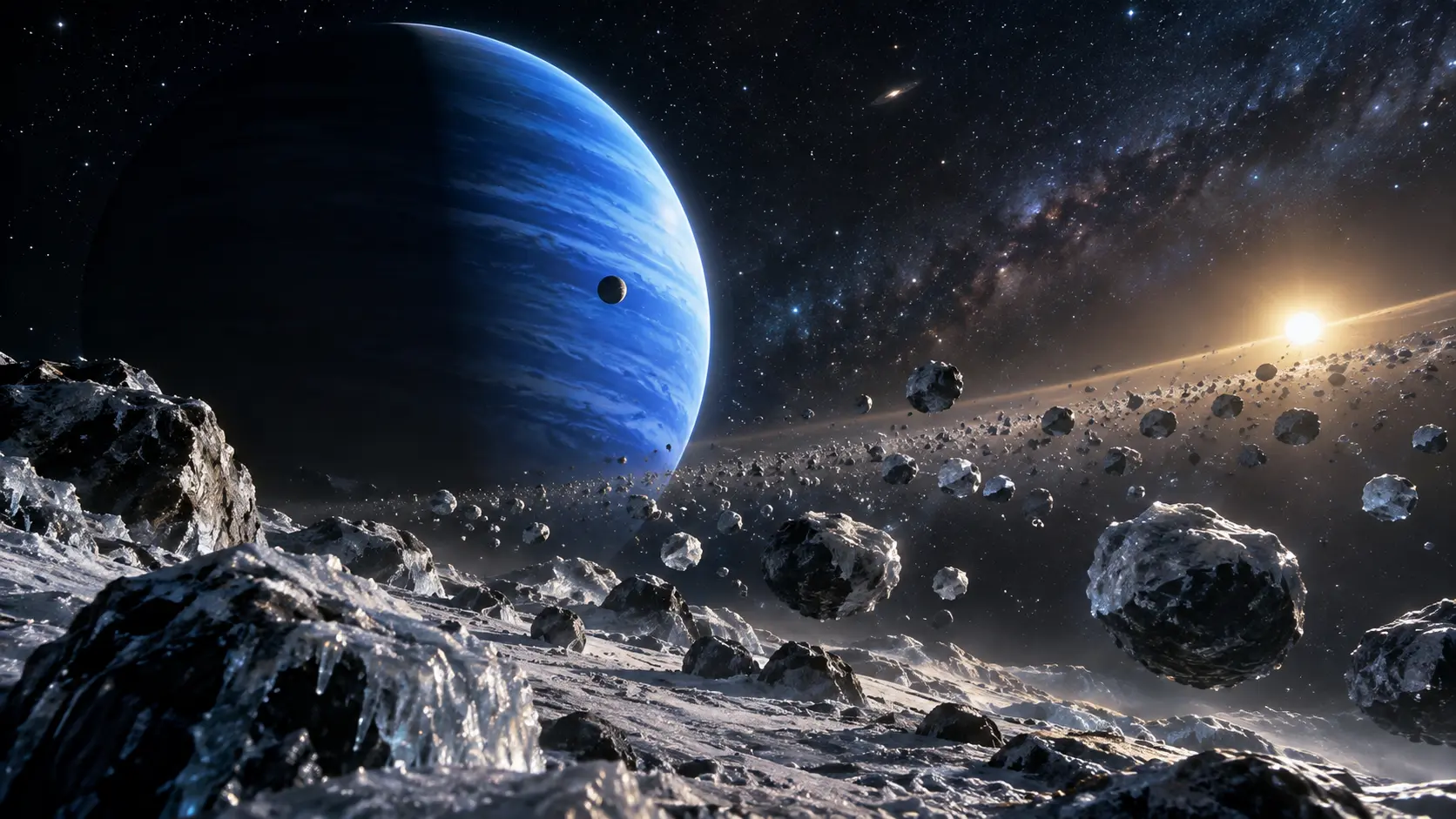
Far beyond Neptune, where sunlight is weak and temperatures plunge hundreds of degrees below freezing, countless icy objects drift through space largely undisturbed. These frozen worlds, known as Trans-Neptunian Objects (TNOs), are often described as leftovers from the Solar System’s formation—a collection of relics that have preserved clues from more than 4.5 billion years ago.
Most of the time, these distant bodies receive little public attention. They are tiny, faint, and incredibly difficult to study.
But a new investigation using two of humanity’s most powerful space telescopes has uncovered something unexpected.
NASA scientists studying objects beyond Neptune found fewer small worlds than existing theories predicted. Even more surprising, some of these tiny objects appear to have preserved characteristics from the earliest days of the Solar System rather than being altered by billions of years of collisions and chaos. The findings are prompting researchers to revisit assumptions about how planets formed and how the outer Solar System evolved.
The discovery may not involve a hidden planet or alien civilization, but it could prove just as important for understanding our cosmic origins.
Looking Beyond Neptune
To understand why this discovery matters, it helps to appreciate what exists beyond Neptune.
The region is home to the Kuiper Belt, a vast ring of icy bodies orbiting the Sun. Pluto is the most famous member, but it is only one of countless objects inhabiting this distant realm.
Scientists view these worlds as fossils from the Solar System’s youth.
Unlike Earth and the other major planets, many of these objects never grew large enough to become planets. Instead, they remained frozen in time, preserving evidence of conditions that existed when the Sun and planets were still forming from a swirling disk of gas and dust.
Studying them is a bit like excavating a prehistoric site.
Each object contains clues about an era that no longer exists.
The challenge is that most of these bodies are extraordinarily difficult to observe. Many are more than 100 million times dimmer than the faintest objects visible to the naked eye. Even powerful ground-based telescopes struggle to detect the smallest examples.
That’s where NASA’s Hubble Space Telescope and James Webb Space Telescope entered the story.
Two Telescopes, One Deep Search
For the first time, researchers combined the strengths of Hubble and Webb to conduct an exceptionally deep survey of Trans-Neptunian Objects.
Hubble observed the objects in visible light while Webb examined them in infrared wavelengths. Together, the telescopes identified and characterized 27 extremely faint objects, some among the smallest and dimmest ever directly studied.
The goal was straightforward.
Scientists wanted to better understand the size, color, composition, and orbital characteristics of these ancient bodies.
What they found was not what many expected.
Researchers anticipated discovering large numbers of tiny objects because traditional models suggested billions of years of collisions should have produced abundant fragments throughout the outer Solar System.
Instead, there were fewer small objects than predicted.
That discrepancy may sound technical, but it has major implications.
It suggests that scientists may not fully understand what happened during the earliest stages of planetary construction.
The Missing Small Worlds
Planet formation begins with dust.
Tiny particles collide and stick together, gradually growing into larger bodies called planetesimals. Over time, some of these planetesimals merge into planets.
Many models predict that this process should leave behind huge numbers of small fragments.
Yet the latest observations indicate the population of tiny objects beyond Neptune is lower than expected.
That raises difficult questions.
Were fewer small bodies created in the first place?
Did collisions destroy them?
Were existing theories overlooking an important process?
Astronomers are still working toward answers.
What makes the puzzle even more interesting is that similar mysteries have appeared before. Earlier Hubble observations also hinted that the outer Solar System contains fewer small objects than some models predicted. The new Hubble-Webb study strengthens the case that something important may be missing from current explanations.
The Objects That Remember the Past
The most intriguing finding may not be the missing worlds.
It may be the worlds that remain.
Researchers examined the colors of the newly observed objects. In planetary science, color is more than appearance. It often serves as a fingerprint of surface composition and history.
Scientists expected that smaller objects would look different from larger ones.
After all, billions of years of impacts should have repeatedly shattered and resurfaced these tiny worlds.
But that isn’t what the data revealed.
Instead, the smallest objects appeared remarkably similar to their larger relatives. Their colors followed the same patterns observed in bigger members of the same populations.
One interpretation is that these bodies somehow preserved information about their origins despite the passage of billions of years.
In other words, they appear to “remember” the conditions under which they formed.
For scientists attempting to reconstruct the Solar System’s history, that is a remarkable possibility.
A Time Capsule From 4.5 Billion Years Ago
The outer Solar System is often described as a deep freeze.
While planets closer to the Sun experienced intense geological activity, melting, collisions, and atmospheric evolution, many distant TNOs remained comparatively untouched.
That makes them valuable scientific targets.
These objects represent an intermediate stage of planet formation—large enough to have formed from dust and pebbles, but not large enough to become full planets. Beyond Neptune, the process effectively stopped before completion.
As a result, today’s TNOs preserve information about a chapter of Solar System history that has largely vanished elsewhere.
Every new observation provides a glimpse into a world billions of years removed from the present.
The latest findings suggest those clues may be even better preserved than researchers previously believed.
Rewriting Planet Formation Models
Scientific progress often begins with something that doesn’t fit expectations.
Astronomers develop models.
Observations test those models.
When reality refuses to cooperate, the science becomes interesting.
The unexpected shortage of small Trans-Neptunian Objects may force researchers to rethink assumptions about planetesimal formation, collision rates, and the early evolution of the Solar System.
One surprising result from the study was that different populations of TNOs showed similar size distributions despite having different formation histories.
Some objects appear to have formed close to their present locations. Others were likely displaced during the migration of the giant planets billions of years ago.
Yet both groups ended up exhibiting remarkably similar characteristics.
That suggests the underlying process responsible for creating planetesimals may be more universal than scientists previously assumed.
If true, the implications extend beyond our own Solar System.
Why Exoplanet Scientists Care
The findings are not just relevant to the history of Earth and its neighboring planets.
They may also help explain how planets form around other stars.
Astronomers have discovered thousands of exoplanets in recent decades. Yet the earliest stages of planet formation remain difficult to observe directly.
The distant objects beyond Neptune offer a rare natural laboratory.
By understanding how planetesimals formed and evolved in our Solar System, scientists can improve theories about planetary systems throughout the galaxy.
In that sense, these tiny frozen worlds have importance far beyond their size.
They help connect the story of our Solar System to the broader story of planetary formation across the universe.
The Edge of the Solar System Keeps Surprising Us
One reason discoveries beyond Neptune capture scientific attention is that the region consistently produces surprises.
Pluto turned out to be far more complex than expected.
The Kuiper Belt proved far larger and more diverse than early astronomers imagined.
Evidence continues to emerge that Neptune’s own system may have been dramatically reshaped by ancient collisions and migrations.
Now the newest observations add another mystery to the list.
Why are there fewer small objects than expected?
How have these worlds preserved evidence of their origins?
And what does that reveal about the chaotic era when planets were first forming?
Scientists do not yet have definitive answers.
But that’s often how breakthroughs begin.
A Discovery Measured in Questions
The most important outcome of this research may not be what astronomers found.
It may be what they failed to find.
The missing small worlds challenge long-standing expectations. The surviving worlds appear to preserve ancient information that should have been erased long ago. Together, those observations hint that parts of the Solar System’s story remain unwritten.
Far beyond Neptune, billions of miles from Earth, a population of frozen objects continues orbiting in darkness.
They are tiny.
They are faint.
And according to NASA’s latest observations, they may still be carrying memories from the birth of the Solar System itself.
The farther astronomers look into the outer reaches of our cosmic neighborhood, the more it becomes clear that the Solar System is not a finished story.
It is a mystery that is still unfolding.