

New Research Is Renewing Interest in the Planet’s Deepest Mystery
Far beneath Earth’s continents and oceans, beyond the crust and mantle, lies a region that humans have never directly observed: the planet’s core. Located thousands of kilometers below the surface, Earth’s core plays a critical role in shaping the magnetic field that protects life from harmful solar radiation and helps stabilize conditions that make the planet habitable.
For decades, scientists viewed changes inside the core as processes that unfolded over millions of years. However, recent research using advanced seismic analysis, satellite observations, and computer modeling is providing evidence that some core-related changes may occur more rapidly than previously thought.
The findings have sparked renewed scientific discussion about the behavior of Earth’s inner layers and whether subtle shifts deep underground could influence everything from magnetic field fluctuations to the length of a day.
While experts emphasize that there is no evidence of an imminent geological catastrophe, ongoing studies are revealing a dynamic interior that may be more active and complex than earlier models suggested.
Understanding Earth’s Hidden Interior
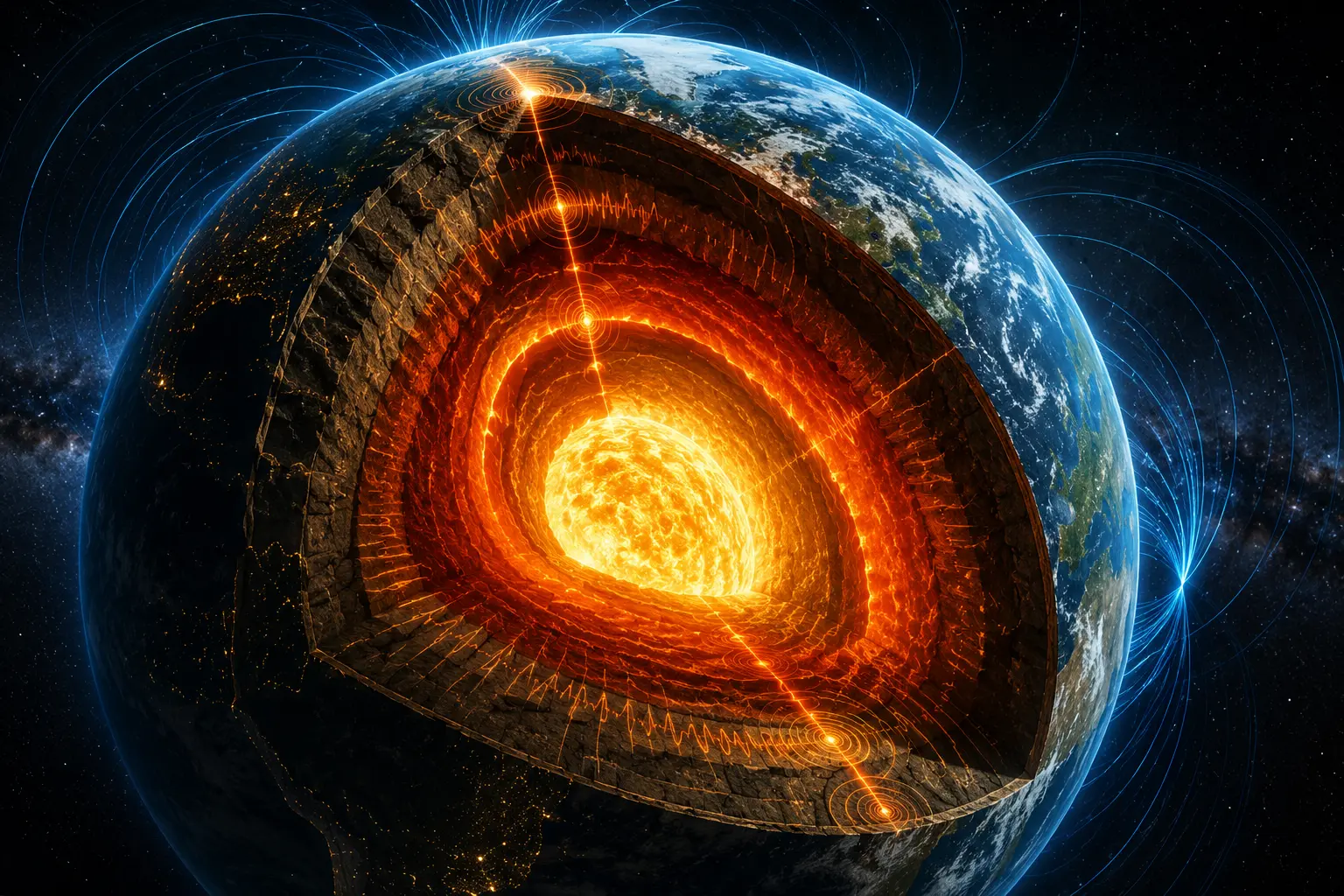
Earth consists of several distinct layers.
The outermost crust is where humans live and where mountains, oceans, and continents exist. Beneath the crust lies the mantle, a thick layer of hot rock slowly moving through convection currents.
At the center of the planet sits the core, which is divided into two parts:
- The liquid outer core
- The solid inner core
The outer core is primarily composed of molten iron and nickel. The movement of this electrically conductive liquid generates Earth’s magnetic field through a process known as the geodynamo.
The inner core, despite temperatures comparable to the surface of the Sun, remains solid because of the immense pressure surrounding it.
For scientists, understanding how these layers interact remains one of the greatest challenges in Earth science.
Unlike oceans or the atmosphere, the core cannot be directly sampled or observed. Researchers must rely on indirect measurements, primarily seismic waves generated by earthquakes, to study what happens deep inside the planet.
Why Scientists Are Reexamining the Core
In recent years, advances in computing power and global seismic monitoring networks have allowed researchers to analyze Earth’s interior with unprecedented precision.
Several studies have suggested that the inner core may not rotate at a constant rate relative to the rest of the planet.
Researchers examining decades of earthquake data have proposed that the inner core may periodically speed up, slow down, or even temporarily reverse its relative motion.
These findings remain the subject of active scientific debate.
Some teams interpret the seismic data as evidence of changes in rotational behavior, while others argue that the observations could result from structural changes within the core itself.
Regardless of the explanation, the research has highlighted the possibility that Earth’s deepest regions may evolve on shorter timescales than previously assumed.
The Inner Core Rotation Debate
One of the most widely discussed topics in geophysics involves the rotation of Earth’s inner core.
For years, scientists believed the solid inner core rotated slightly faster than the planet’s surface.
However, newer analyses have suggested a more complicated picture.
According to some studies, the inner core’s rotation relative to the mantle may fluctuate over decades rather than remaining constant.
If confirmed, these changes could be linked to interactions between the solid inner core and the liquid outer core that surrounds it.
The forces involved are immense.
Magnetic interactions, gravitational influences, and fluid dynamics within the molten outer core may all contribute to the behavior scientists observe through seismic measurements.
Experts caution that these changes occur extremely slowly from a human perspective and do not pose any direct threat to daily life.
Nevertheless, they offer important clues about how Earth’s internal engine operates.
Could Changes Affect Earth’s Magnetic Field?
The possibility of faster-than-expected core changes has drawn attention because of the core’s relationship with Earth’s magnetic field.
The magnetic field acts as a protective shield, deflecting charged particles from the Sun and helping preserve the atmosphere.
Scientists have long known that the magnetic field is not constant.
Its strength fluctuates over time, and magnetic poles gradually drift.
In fact, Earth’s magnetic north pole has been moving significantly faster during recent decades than it did in earlier periods.
Researchers continue to investigate whether subtle changes in the outer core’s molten iron flow could be contributing to these observations.
Current evidence suggests the magnetic field remains stable enough to continue performing its protective role.
However, understanding how deep-Earth processes influence magnetic behavior remains a major area of scientific research.
The Mystery of Geomagnetic Reversals
Another reason scientists closely monitor the core is its connection to geomagnetic reversals.
Throughout Earth’s history, the magnetic north and south poles have switched positions many times.
Geological records preserved in ancient rocks show that these reversals have occurred repeatedly over millions of years.
A reversal does not happen overnight.
Instead, it unfolds gradually over thousands of years.
Some researchers have questioned whether present-day magnetic field changes could signal the early stages of a future reversal.
Most experts say there is currently insufficient evidence to make such a conclusion.
Nevertheless, studying the core provides valuable information about the mechanisms that drive these rare but significant planetary events.
Seismic Technology Is Transforming Deep-Earth Science
Modern advances in seismic monitoring have dramatically improved scientists’ ability to study the core.
Thousands of seismic stations around the world continuously record vibrations generated by earthquakes.
As seismic waves travel through Earth, they behave differently depending on the material they encounter.
By analyzing how these waves change speed, direction, and intensity, researchers can create increasingly detailed maps of the planet’s interior.
Artificial intelligence and machine learning tools are now helping scientists process enormous seismic datasets.
These technologies can identify patterns that might previously have gone unnoticed.
The result is a more detailed picture of Earth’s deepest structures and a growing understanding of how they evolve over time.
What Computer Simulations Reveal
Alongside seismic observations, computer simulations are becoming an essential tool for studying the core.
Supercomputers can model conditions impossible to reproduce directly in laboratories.
Researchers use these simulations to explore how molten metals move under extreme temperatures and pressures.
The models suggest that interactions within the core may be more dynamic than earlier generations of scientists believed.
Complex flows of liquid iron, magnetic forces, and thermal variations can create changing conditions over surprisingly short geological timescales.
These findings are helping researchers test competing theories about core behavior and refine predictions about future changes.
Could Core Changes Influence Earth’s Rotation?
One intriguing question involves whether activity inside the core can affect Earth’s rotation.
Scientists have observed tiny variations in the length of a day over time.
These changes are extremely small, typically measured in milliseconds.
Several factors influence Earth’s rotation, including atmospheric circulation, ocean currents, and gravitational interactions with the Moon.
Some researchers believe movements within the core may also contribute.
As mass shifts inside the planet, it can slightly alter rotational dynamics.
The effect is far too small for humans to notice directly.
However, understanding these subtle influences helps scientists build more accurate models of Earth’s overall behavior.
What the Research Does—and Does Not—Mean
Public interest in Earth’s core often increases when studies suggest unexpected activity deep below the surface.
However, experts stress the importance of interpreting findings carefully.
The phrase “changing faster than expected” does not imply a looming disaster.
Instead, it reflects a growing scientific realization that some internal processes may occur on decadal or century-long timescales rather than exclusively over millions of years.
There is no evidence that recent observations indicate an impending earthquake surge, volcanic crisis, or planetary instability.
The changes under discussion involve highly complex processes occurring thousands of kilometers beneath Earth’s surface.
For scientists, the significance lies in improving understanding rather than predicting catastrophe.
A Frontier of Scientific Discovery
Despite centuries of geological research, Earth’s core remains one of the least understood regions of the planet.
The deepest human-made boreholes have penetrated only a tiny fraction of the distance needed to reach the mantle, let alone the core.
As a result, much of what scientists know comes from indirect observations and theoretical modeling.
New technologies are gradually changing that picture.
Improved seismic networks, satellite measurements, artificial intelligence, and advanced computing systems are allowing researchers to study Earth’s interior in ways that were impossible just a generation ago.
Each new discovery helps refine our understanding of how the planet functions as an interconnected system.
The Bottom Line
The question of whether Earth’s core is changing faster than expected reflects an exciting period in geophysical research rather than a cause for alarm.
Emerging evidence suggests that some processes deep within the planet may be more dynamic and variable than scientists once believed.
Researchers continue to investigate changes in inner-core rotation, molten iron flow, magnetic field behavior, and other phenomena that shape Earth’s interior.
While many uncertainties remain, the growing body of evidence points toward a planet whose deepest layers are far from static.
Understanding those changes could improve knowledge of Earth’s magnetic field, rotational behavior, and long-term geological evolution.
For now, scientists agree on one thing: Earth’s core still holds many secrets, and the technologies being developed today may soon reveal answers to some of the biggest mysteries hidden beneath our feet.


