

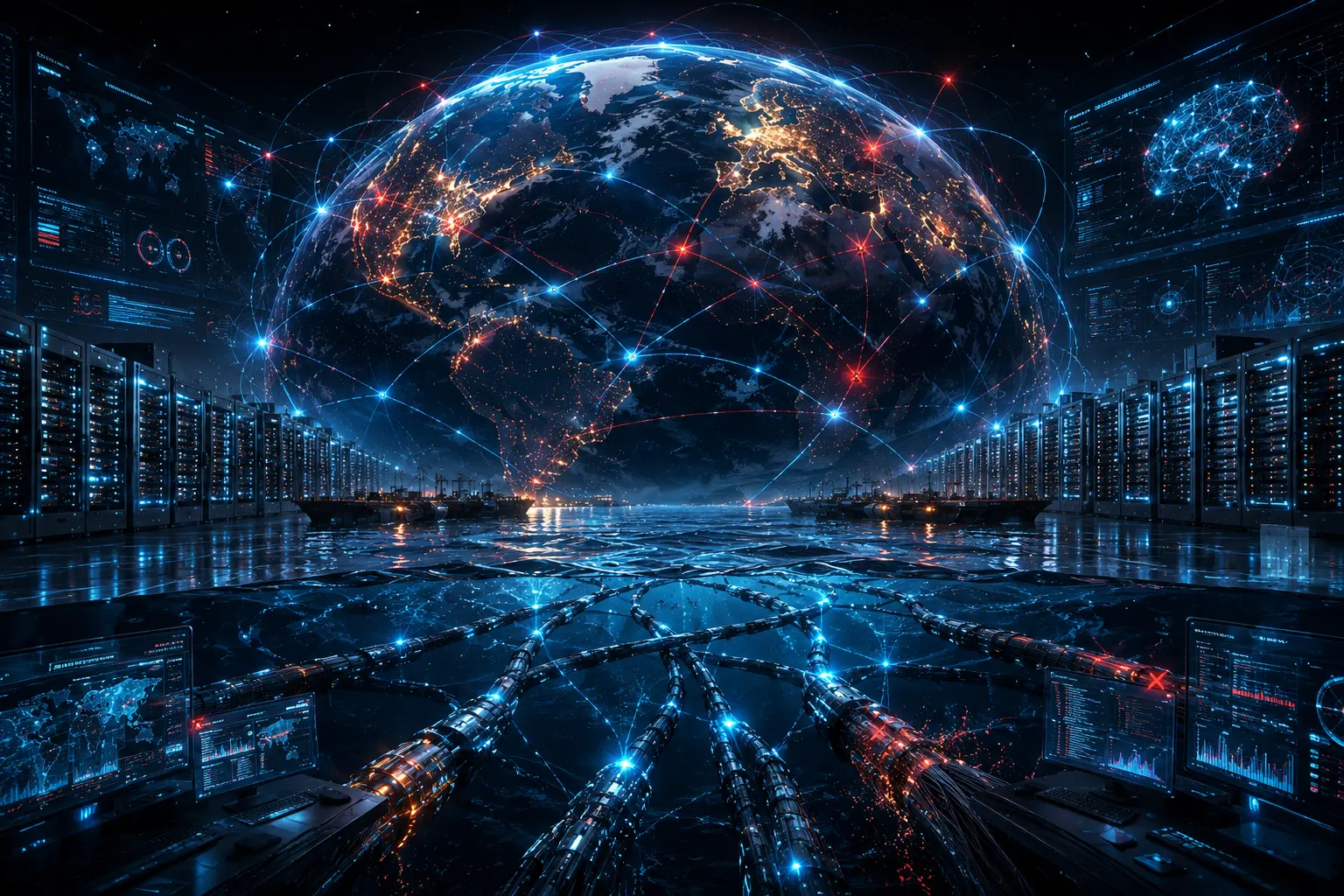
Could Humanity’s Most Connected System Be One Mistake Away From Collapse?
The internet has become so deeply embedded in modern life that many people treat it as a permanent feature of civilization. Governments rely on it to deliver services. Banks use it to move trillions of dollars daily. Hospitals, airlines, emergency responders, power grids, and global businesses all depend on a network that spans continents and oceans.
Yet cybersecurity researchers, network engineers, and infrastructure experts have increasingly warned that some emerging technologies designed to strengthen or accelerate digital communications could, under certain circumstances, create risks capable of disrupting the internet on an unprecedented scale.
The threat is not a Hollywood-style doomsday machine hidden in a secret laboratory. Instead, experts point to a combination of advanced artificial intelligence, automated network systems, quantum computing developments, and the growing concentration of internet infrastructure as technologies that could accidentally trigger cascading failures across the global network.
While the internet is designed to survive localized outages, specialists say an unexpected interaction between highly automated systems could potentially create disruptions unlike anything previously experienced.
Why the Internet Is More Fragile Than It Appears
At first glance, the internet looks indestructible.
Every day, billions of users exchange emails, stream videos, conduct financial transactions, and access cloud services without considering the complex infrastructure behind the scenes.
The internet is not a single network. It is a vast collection of interconnected networks operated by telecommunications companies, cloud providers, governments, universities, and private organizations.
These networks communicate through protocols that allow data to travel across the globe in milliseconds.
The system was originally designed with resilience in mind. If one route fails, traffic can usually find another path.
However, resilience does not mean invulnerability.
Several incidents over the past two decades have demonstrated how small technical mistakes can have enormous consequences.
Configuration errors have temporarily disconnected major regions from the internet. Software bugs have disrupted critical services. Accidental routing announcements have redirected global traffic to unintended destinations.
In most cases, engineers resolved the problems quickly.
The concern today is that increasingly automated technologies could amplify such errors far beyond previous limits.
The Rise of Autonomous Network Management
One of the biggest technological shifts occurring in the internet industry involves automation.
Modern networks are becoming too large and complex for humans to manage manually.
As a result, telecommunications providers and cloud companies increasingly use AI-driven systems to monitor traffic, optimize routing, detect failures, and allocate resources automatically.
These systems can react faster than human operators.
They can identify congestion, reroute traffic, and respond to cyberattacks in seconds.
The efficiency benefits are significant.
However, experts warn that autonomous systems can also behave unpredictably when interacting with other autonomous systems.
If multiple AI-powered networks begin making decisions simultaneously based on incomplete or misleading information, unintended feedback loops could emerge.
A routing change by one network could trigger a reaction in another network. That reaction could prompt additional automated adjustments elsewhere.
In extreme scenarios, researchers say cascading responses could spread faster than humans can intervene.
The result might be widespread service disruptions affecting major portions of the global internet.
Artificial Intelligence and the Risk of Cascading Failures
Artificial intelligence has become central to digital infrastructure management.
Cloud providers use AI to optimize data centers. Internet providers deploy machine-learning systems to identify anomalies. Security companies use AI to detect threats.
While AI can improve reliability, it introduces new complexities.
Machine-learning systems often operate as “black boxes,” meaning their decision-making processes are not always fully understood even by their developers.
This creates challenges when AI systems are placed in control of critical infrastructure.
Researchers have raised concerns about scenarios where multiple AI systems independently reach decisions that are logical locally but harmful globally.
For example, if several networks simultaneously redirect traffic away from what they perceive as a congestion point, they could unintentionally overwhelm alternate routes.
The resulting congestion could trigger further automated responses, creating a cycle that rapidly expands across interconnected systems.
Such events remain theoretical, but specialists increasingly study them as internet automation accelerates.
Quantum Computing: A Future Challenge
Another technology drawing attention is quantum computing.
Quantum computers have the potential to solve certain problems dramatically faster than traditional computers.
Scientists believe quantum technology could revolutionize medicine, materials science, and complex simulations.
However, cybersecurity experts have also identified significant risks.
Much of the internet’s security depends on encryption systems that protect banking transactions, communications, and sensitive data.
Many existing encryption methods could eventually become vulnerable to sufficiently powerful quantum computers.
If a breakthrough in quantum computing arrives before widespread adoption of quantum-resistant encryption, attackers could potentially compromise critical communications systems.
While this would not physically destroy the internet, it could undermine trust in the network itself.
Financial systems, government communications, and online authentication mechanisms could face major challenges.
International standards organizations and technology companies are already working to develop next-generation encryption designed to resist future quantum attacks.
Nevertheless, the transition represents one of the largest cybersecurity projects in internet history.
The Hidden Vulnerability of Internet Concentration
Ironically, one of the internet’s greatest strengths has become a potential weakness.
Over time, internet infrastructure has become increasingly concentrated.
A relatively small number of cloud providers, content delivery networks, and major data center operators now handle enormous portions of global internet traffic.
This concentration has improved efficiency and reduced costs.
It has also created critical dependency points.
When a major cloud provider experiences an outage, thousands of websites and applications can become unavailable simultaneously.
Recent years have seen several high-profile disruptions affecting online services across multiple countries.
Most outages lasted only hours.
Yet experts warn that increasing dependence on a handful of infrastructure providers creates systemic risks.
If advanced automation, software failures, or unforeseen interactions affected multiple major providers simultaneously, the consequences could be far more severe than traditional outages.
Could a Software Update Trigger Global Chaos?
One of the most realistic scenarios discussed by experts involves software errors.
Modern internet infrastructure depends on countless software systems working together.
Updates are deployed continuously.
Many organizations release new code multiple times per day.
While testing procedures are rigorous, history shows that software bugs can still produce unexpected consequences.
A faulty update affecting a widely used networking platform could potentially spread rapidly across interconnected systems.
If automated deployment mechanisms distribute problematic software globally before issues are detected, disruptions could affect vast portions of internet infrastructure.
Recent cybersecurity incidents have demonstrated how quickly software-related disruptions can spread across industries.
The increasing scale and complexity of digital systems make preventing every possible failure extraordinarily difficult.
The Role of Undersea Cables
Few internet users think about the physical infrastructure beneath the oceans.
More than 95% of international internet traffic travels through undersea fiber-optic cables connecting continents.
These cables form the backbone of global connectivity.
Emerging technologies are helping operators monitor cable health, optimize performance, and improve reliability.
At the same time, increasing dependence on these systems highlights another dimension of internet vulnerability.
Natural disasters, accidental damage, equipment failures, or operational errors affecting multiple major cable routes could create significant disruptions.
While global networks generally include redundancy, experts continue to stress the importance of infrastructure diversity and resilience planning.
Cybersecurity Experts Urge Caution
The possibility of accidentally “destroying” the internet does not mean a permanent shutdown is likely.
Most experts view a complete and irreversible collapse as extremely improbable.
The internet’s distributed architecture remains one of its strongest defenses.
Instead, researchers focus on scenarios involving prolonged, large-scale disruptions that could take days, weeks, or even months to fully recover from.
Such events could have profound economic consequences.
Modern economies rely heavily on digital communications, cloud computing, electronic payments, and online services.
A major internet disruption would affect transportation, healthcare, commerce, education, media, and government operations.
For this reason, cybersecurity professionals increasingly advocate for resilience-focused development.
Rather than prioritizing speed and efficiency alone, experts recommend designing systems that can fail safely and recover quickly.
Governments and Industry Are Responding
Governments around the world have begun investing heavily in cyber resilience initiatives.
National cybersecurity agencies routinely conduct exercises simulating large-scale internet disruptions.
Technology companies are also expanding investments in redundancy, backup systems, and advanced monitoring tools.
International organizations have launched efforts to improve coordination between network operators, cloud providers, and infrastructure managers.
The goal is to ensure that localized failures remain localized rather than spreading through interconnected systems.
Researchers are also developing new methods to verify AI-driven infrastructure decisions before they are implemented.
These safeguards aim to reduce the risk of automated systems triggering unintended consequences.
The Future of the Internet
The technologies that power the modern internet continue to evolve rapidly.
Artificial intelligence promises smarter networks. Quantum computing offers revolutionary capabilities. Automation enables faster responses to failures and threats.
Yet history shows that every technological advancement introduces new challenges alongside new opportunities.
The question facing engineers is not whether future systems will become more powerful.
The question is whether humanity can maintain sufficient oversight, transparency, and resilience as those systems grow increasingly autonomous.
The internet has survived cyberattacks, natural disasters, infrastructure failures, and unprecedented growth over the past several decades.
Its future will likely depend on balancing innovation with caution.
The technology most capable of accidentally disrupting the internet may ultimately be the same technology designed to make it stronger.
As AI, automation, and advanced computing reshape the digital world, experts say the greatest threat may not come from malicious actors but from unintended consequences emerging from systems too complex for any single organization—or individual—to fully understand.
For now, the internet remains operational, resilient, and expanding.
But the technologies being built today will determine whether tomorrow’s internet becomes more secure—or whether humanity inadvertently creates the conditions for its largest digital disruption yet.


