
For generations, history textbooks told a familiar story.
First came agriculture. Once humans learned to grow crops and domesticate animals, they settled down in permanent communities. Villages grew into towns. Towns became cities. Religion, monumental architecture, and organized societies emerged later as a result of that transformation.
It was a logical sequence.
Or so we thought.
Then archaeologists uncovered a site in southeastern Turkey that forced researchers to reconsider one of the most fundamental assumptions about human civilization.
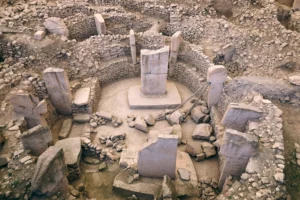
Hidden beneath a windswept hill known as Göbekli Tepe, enormous stone pillars stood in silent circles for thousands of years. They were not built by kings. They were not erected by a powerful empire. They were created by hunter-gatherers living nearly 12,000 years ago—long before Stonehenge, long before the Egyptian pyramids, and at a time when conventional wisdom suggested humans were incapable of such monumental construction.
Today, Göbekli Tepe is considered one of the most important archaeological discoveries ever made. It has transformed how scholars think about the origins of religion, social organization, and the rise of civilization itself.
The site does not merely add another chapter to human history.
It may have rewritten the opening pages.
A Hill With a Secret
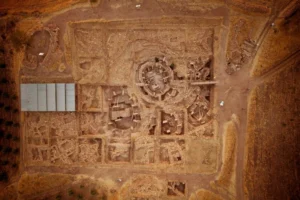
Göbekli Tepe sits in the Germuş Mountains near modern-day Şanlıurfa in southeastern Türkiye. For centuries, it appeared to be little more than an ordinary hill rising above the surrounding landscape.
Local farmers noticed unusual stones scattered across the surface, but few imagined what lay beneath.
The site was first recorded during an archaeological survey in the 1960s, but its true significance remained unrecognized. That changed in the 1990s when German archaeologist Klaus Schmidt visited the location and realized the hill concealed something extraordinary. Excavations soon revealed massive stone enclosures unlike anything previously known from that era.
What emerged from the soil stunned archaeologists.
Huge T-shaped limestone pillars stood arranged in circular and oval formations. Some rose more than five meters high and weighed several tons. Many were decorated with intricate carvings of animals, including foxes, snakes, wild boars, birds, gazelles, and scorpions.
The structures were clearly intentional.
They were monumental.
And they were astonishingly old.
Older Than Stonehenge. Older Than the Pyramids.
Radiocarbon dating placed the earliest phases of Göbekli Tepe between roughly 9600 and 8200 BCE, making parts of the site around 11,500 to 12,000 years old.
To appreciate the significance of that date, it helps to compare it with other famous monuments.
Stonehenge would not be built for another six thousand years.
The Great Pyramid of Giza was still seven thousand years in the future.
Writing had not yet been invented.
Metalworking was unknown.
The wheel did not exist.
Human societies were still living in the transition between the last Ice Age and the dawn of agriculture.
Yet somehow, people were quarrying, transporting, carving, and arranging enormous stone pillars into sophisticated architectural complexes.
That fact alone challenged long-standing assumptions about what prehistoric humans could achieve.
The Mystery of the Builders
One of the most remarkable aspects of Göbekli Tepe is who built it.
Evidence suggests the site’s creators were hunter-gatherers rather than fully developed farming communities. Animal remains recovered from the area are overwhelmingly from wild species. Researchers have found signs that the builders relied heavily on hunting and gathering rather than established agriculture.
This discovery surprised archaeologists.
For decades, many scholars believed monumental architecture required settled agricultural societies capable of producing food surpluses.
The logic seemed straightforward.
Large construction projects require labor.
Labor requires organization.
Organization requires stable food supplies.
Agriculture provides those supplies.
But Göbekli Tepe appears to complicate that sequence.
Here was evidence that groups of hunter-gatherers were capable of organizing massive communal projects before agriculture had fully emerged.
Instead of agriculture creating civilization, some researchers began asking a provocative question:
What if the desire to gather, cooperate, and participate in shared rituals helped encourage the development of agriculture?
The implications were profound.
The World’s First Monumental Architecture?
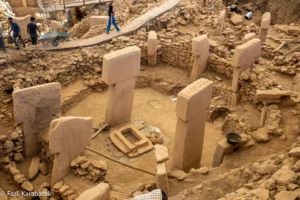
UNESCO describes Göbekli Tepe as one of the earliest known examples of monumental architecture created by human beings. The site contains large megalithic structures featuring distinctive T-shaped pillars that represent a major leap in construction and engineering capabilities.
The pillars themselves are fascinating.
Many appear to be stylized representations of human figures. Some include carved arms, hands, belts, and loincloths. The T-shape may symbolize the human body, with the horizontal section representing the head.
The craftsmanship is impressive even by modern standards.
Builders extracted limestone blocks from nearby quarries, shaped them with stone tools, transported them across the landscape, and positioned them with remarkable precision.
Accomplishing such work required planning, coordination, and specialized skills.
These were not random constructions.
They were carefully designed monuments.
The Animals in Stone
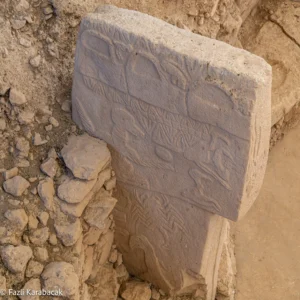
Walk among the pillars of Göbekli Tepe and one feature immediately captures attention.
Animals are everywhere.
Foxes sprint across stone surfaces.
Snakes twist and coil.
Birds spread their wings.
Wild boars, gazelles, insects, and predators appear throughout the site.
The carvings are among the oldest large-scale stone artworks ever discovered.
Yet their meaning remains uncertain.
Some researchers believe they reflect spiritual beliefs or mythological traditions.
Others suggest they may represent clan symbols, territorial markers, or important animals within local ecosystems.
The truth is that nobody knows for certain.
These carvings emerged from a world that left no written records.
Their creators cannot explain their intentions.
The stones must speak for themselves.
And they still have many secrets to reveal.
A Place of Ritual?
One of the most widely discussed questions surrounding Göbekli Tepe is its purpose.
Why was it built?
Many archaeologists believe the site had ritual or ceremonial significance. The layout of the enclosures, the symbolic carvings, and the scale of construction all suggest activities beyond ordinary daily life. UNESCO notes that the monuments were likely connected to communal rituals or social gatherings.
Some researchers have described the site as the world’s oldest known temple complex, although interpretations continue to evolve as new discoveries emerge.
If the site served religious or ceremonial purposes, it would represent something extraordinary.
It would suggest that organized belief systems capable of bringing together large groups of people existed far earlier than once believed.
That possibility has fascinated scholars for decades.
Religion may not have emerged after civilization.
In some respects, it may have helped create the conditions for civilization to develop.
Geometry and Planning
For many years, archaeologists assumed the various enclosures at Göbekli Tepe were built independently over time.
Then researchers applied modern analytical techniques.
The results hinted at something unexpected.
Studies examining the layout of major enclosures found evidence suggesting they may have been planned as part of a coordinated design. Geometric relationships between structures indicate a level of architectural planning more sophisticated than previously assumed.
This discovery matters because it suggests abstract thinking on a significant scale.
The builders were not merely stacking stones.
They were designing spaces according to organized concepts and patterns.
Such planning requires communication, shared goals, and advanced cognitive abilities.
In other words, these people were thinking far more like architects than many historians once imagined.
Why Was It Buried?
Perhaps the greatest mystery surrounding Göbekli Tepe is not how it was built.
It is why it disappeared.
At some point, many of the site’s monumental structures were deliberately buried beneath tons of soil and debris. The process appears to have been intentional rather than the result of natural forces.
Why would people invest enormous effort constructing these monuments only to bury them?
Numerous theories have been proposed.
Perhaps social beliefs changed.
Perhaps communities migrated elsewhere.
Perhaps new cultural traditions emerged.
Maybe the burial itself held symbolic significance.
At present, no definitive answer exists.
The deliberate burial may actually be one reason the site survived so well.
Covered and protected for millennia, the structures remained hidden until archaeologists uncovered them thousands of years later.
Rewriting the Story of Civilization
Before Göbekli Tepe, many scholars viewed monumental architecture as a consequence of settled agricultural life.
After Göbekli Tepe, that narrative became more complicated.
The site demonstrated that hunter-gatherers were capable of creating large-scale communal projects involving advanced planning, symbolic art, engineering, and social coordination.
That realization has forced archaeologists to reconsider long-held assumptions.
Civilization may not have developed in a neat sequence.
Human societies are often more innovative, adaptable, and complex than traditional models suggest.
Göbekli Tepe serves as a reminder that history is rarely as straightforward as textbooks make it appear.
Sometimes a single discovery can overturn decades of accepted thinking.
What Lies Beneath?
Another reason Göbekli Tepe remains so important is that much of it has not yet been excavated.
Researchers estimate that only a small portion of the site has been fully explored. Geophysical surveys suggest additional structures remain hidden beneath the ground.
That means future discoveries are almost inevitable.
New carvings may emerge.
Additional enclosures may be uncovered.
Fresh evidence could reshape existing interpretations.
Each excavation season has the potential to reveal another piece of the puzzle.
Archaeologists are not simply studying the past.
They are actively uncovering it.
A UNESCO World Heritage Site
In 2018, Göbekli Tepe was officially inscribed on the UNESCO World Heritage List. The designation recognized the site’s extraordinary significance as one of humanity’s earliest examples of monumental architecture and as a key window into the transition from hunter-gatherer societies to the first farming communities.
Today, visitors from around the world travel to southeastern Türkiye to see the site for themselves.
Protected beneath a modern shelter, the ancient pillars stand as they have for millennia.
Silent.
Mysterious.
Endlessly fascinating.
The Discovery That Changed Everything
Archaeology occasionally produces discoveries that fill gaps in history.
Göbekli Tepe did something rarer.
It changed the questions historians ask.
Instead of simply revealing another ancient settlement, it challenged assumptions about religion, cooperation, architecture, and the origins of civilization itself.
Twelve thousand years ago, groups of people gathered on a hilltop overlooking the landscape of Upper Mesopotamia.
They carved stone.
Raised monuments.
Created symbols.
And left behind a legacy that would remain hidden for thousands of years.
Today, those monuments continue to reshape our understanding of who we are and where we came from.
The stones of Göbekli Tepe do not merely tell a story about the distant past.
They remind us that human history is still full of surprises.
And sometimes, the discoveries that change everything have been waiting beneath our feet all along.


